Question
Explain how a potentiometer is used as a voltage divider.

Answer

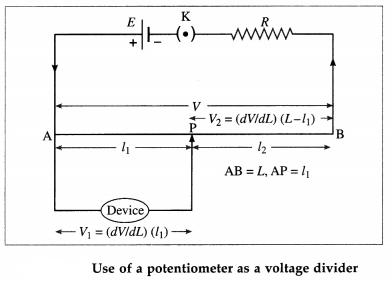
A potentiometer can be used as a voltage divider to continuously change the output voltage of a voltage supply. As shown in the below figure, potential difference $V$ is set up between points $A$ and $B$ of a potentiometer wire. One end of a device is connected to positive point $A$ and the other other end is connected to a slider that can move along wire $AB.$ The voltage $V$ divides in proportion of lengths $l_1$ and $l_2$ as shown in figure.
Image
By using the slider we can change the output voltage from $0$ to $V.$

Need a full question paper?

Generate a complete, print-ready paper with questions like this in minutes — across 16+ boards, with answer keys.
Start Generating Free

Similar questions

State the expressions for the kinetic energy (KE) and potential energy (PE) at a displacement $x$ for a particle performing linear SHM. Find
(i) the displacement at which $KE$ is equal to $PE$
(ii) the $KE$ and $PE$ when the particle is halfway to a extreme position.
Find the pressure $200 m$ below the surface of the ocean if pressure on the free surface of liquid is one atmosphere. (Density of sea water $=1060 kg / m ^3$ )
A $20\ cm$ wide thin circular disc of mass $200\ g$ is suspended to a rigid support from a thin metallic string. By holding the rim of the disc, the string is twisted through 60° and released. It now performs angular oscillations of period $1$ second. Calculate the maximum restoring torque generated in the string under undamped conditions. $(\pi ^3 ≈ 31)$
 
Find the number of molecules in $1 \mathrm{~cm}^3$ of oxygen at a pressure of $105 \mathrm{~N} / \mathrm{m}^2$ if the rms speed of oxygen molecules is $426 \mathrm{~m} / \mathrm{s}$. What is the temperature of the gas? (Mass of an oxygen molecule $=5.28 \times 10^{-26} \mathrm{~kg}, \mathrm{k}_{\mathrm{B}}=1.38 \times 10^{-23} \mathrm{~J} / \mathrm{K}$ )
Derive expressions for the period of SHM in terms of
(1) angular frequency
(2) force constant
(3) acceleration.
An object of mass $0.5 kg$ performs SHM with force constant $10 N / m$ and amplitude $3 cm$.
(i) What is the total energy of the object?
(ii) What is its maximum speed?
(iii) What is its speed at $x=2 cm$ ?
(iv) What are its kinetic and potential energies at $x=2 cm$ ?
(1) If there are n parallel plates then there will be $(n-1)$ capacitors, hence
$
C=(n-1) \frac{A \varepsilon_0}{d}
$
(2) For a spherical capacitor, consisting of two concentric spherical conducting shells with inner and outer radii as $a$ and $b$ respectively, the capacitance $C$ is given by $C=4 \pi \varepsilon_0\left(\frac{a b}{b-a}\right)$
(3) For a cylindrical capacitor, consisting of two coaxial cylindrical shells with radii of the inner and outer cylinders as $a$ and $b$, and length $I$, the capacitance $C$ is given by
$
C=\frac{2 \pi \varepsilon_0 \ell}{\log _e \frac{b}{a}}
$
Define:
(1) retentivity
(2) coercivity.
In Young's double$-$slit experiment with slits of equal width, a point $P$ on the screen is at a distance equal to one$-$fourth of the fringe width from the central maximum. If the intensity at the central maximum is $I_0$ find the intensity at $P$.
Whitelight consists of wavelengths from $400\ nm$ to $700\ nm.$ What will be the wavelength range seen when white light is passed through glass of refractive index $1.55?$