Question
Explain how does the polarized dielectric modify the original external field inside it ?

Answer

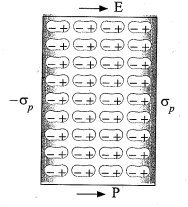
As shown in the figure, consider a rectangular (/ cuboid) dielectric slab placed in a uniform external field $\overrightarrow{ E _0}$.
Due to this, the dipole moments are aligned almost parallel to $\overrightarrow{ E _0}$.

Image
The situation shown in the figure is an ideal situation, at 0K (zero kelvin) temperature, The external field causes almost uniform polarization $\overrightarrow{ P }$ of the dielectric, Thus every volume element $\Delta V$ of the slab has a dipole moment $\overrightarrow{ P } \Delta V$.
Inside the dielectric, the net charge inside the volume element $\Delta V$ is zero. This is because the positive charge of one dipole sits close to and hence cancels out the effect of the negative charge of the neighbouring dipole. However, at the surface of the dielectric net, surface density is not zero because as shown in the figure, the positive ends of the dipoles remain unneutralized at the right surface and the negative ends at the left surface. These unbalanced charges are the induced charges due to the external electric field. Therefore, there is some net surface charge density on the surface of the dielectric.
The induced electric charge is also known as bound charge.
Thus the polarized dielectric is equivalent to two charged surfaces with induced surface charge densities, say $\sigma_p$ and $-\sigma_p$.
The field produced by these surface charges opposes the external electric field. The total field in the dielectric is, there by, reduced.

Need a full question paper?

Generate a complete, print-ready paper with questions like this in minutes — across 16+ boards, with answer keys.
Start Generating Free

Similar questions

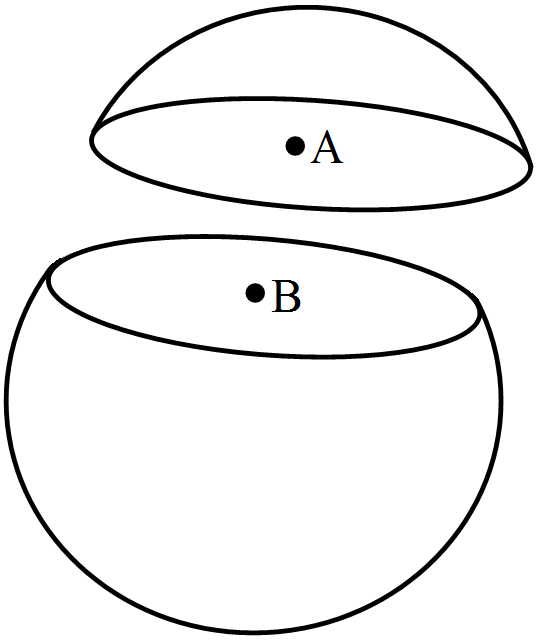
A thin spherical shell having uniform density is cut in two parts by a plane and kept separated as shown in figure (11-E3). The point A is the centre of the plane section of the first part and B is the centre of the plane section of the second part. Show that the gravitational field at A due to the first part is equal in magnitude to the gravitational field at B due to the second part.
If we put a cardboard (say 20cm × 20cm) between a light source and our eyes, we can't see the light. But when we put the same cardboard between a sound source and our ear, we hear the sound almost clearly. Explain.
On a hot summer day we want to cool our room by opening the refrigerator door and closing all the windows and doors. Will the process work ?
Find the maximum wavelength of electromagnetic radiation which can create a hole-electron pair in germanium. The band gap in germanium is 0.65eV.
Estimate the average drift speed of conduction electrons in a copper wire of cross-sectional area $1.0 \times 10^{-7} \mathrm{~m}^2$ carrying a current of 1.5 A . Assume the density of conduction electrons to be $9 \times 10^{28} \mathrm{~m}^{-3}$.
The distance between the two plates of a parallel plate capacitor is 4 mm . A 3 mm thick dielectric strip having dielectric constant 3 is placed between the plates parallel to the plates. The distance between the plates is arranged in such a way that the capacitance of the capacitor becomes $2 / 3$ of the initial capacitance. What is the new distance between the plates?
The distance between the cathode (filament) and the target in an X-ray tube is 1.5m. If the cutoff wavelength is 30pm, find the electric field between the cathode and the target.
Write Snell's law and derive its general equation.
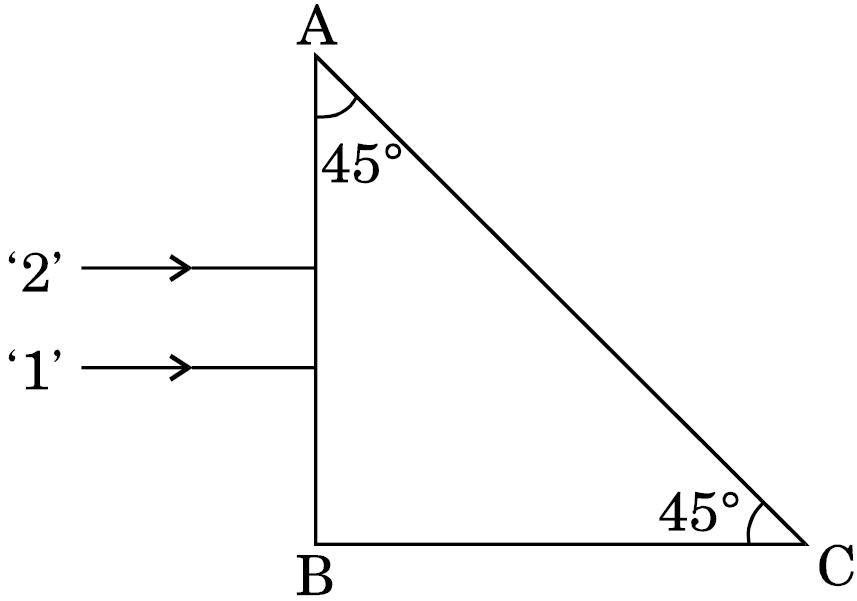
Two monochromatic rays of light are incident normally on the face AB of an isosceles right-angled prism ABC. The refractive indices of the glass prism for the two rays ‘1’ and ‘2’ are respectively 1.3 and 1.5 Trace the path of these rays after entering through the prism.
Write the shortcomings of Rutherford atomic model. Explain how these were overcome by the postulates of Bohr's atomic model.