Question
Explain how electric conduction becomes possible in metallic conductor and in electrolytic conductors.

Answer

Conductors possess mobile charge carriers. In metallic conductors, there are free electrons as electric charge carriers.
In metal electrons in the outer most orbit Valence electrons part away from their atoms and they are free to move. These electrons are free to move within metal, but they are not free to leave metal.
These free electrons collide with each other and with other ions, and move randomly in different directions.
The positive ions made of bound electrons and nuclei remain held in their fixed positions.
In electrolytic conductors, the charge carriers are both positive and negative ions, but the movement of the charge carriers is affected by both the external field as well as the chemical forces.
Need a full question paper?

Generate a complete, print-ready paper with questions like this in minutes — across 16+ boards, with answer keys.

Start Generating Free

Similar questions

A particle moves from a point $\vec{\text{r}}_1=(2\text{m})\vec{\text{i}}+(3\text{m})\vec{\text{j}}$ to another point $\vec{\text{r}}_2=(3\text{m})\vec{\text{i}}+(2\text{m})\vec{\text{j}}$ during which a certain force $\vec{\text{F}}=(5\text{N})\vec{\text{i}}+(5\text{N})\vec{\text{j}}$ acts on it. Find the work done by the force on the particle during the displacement.
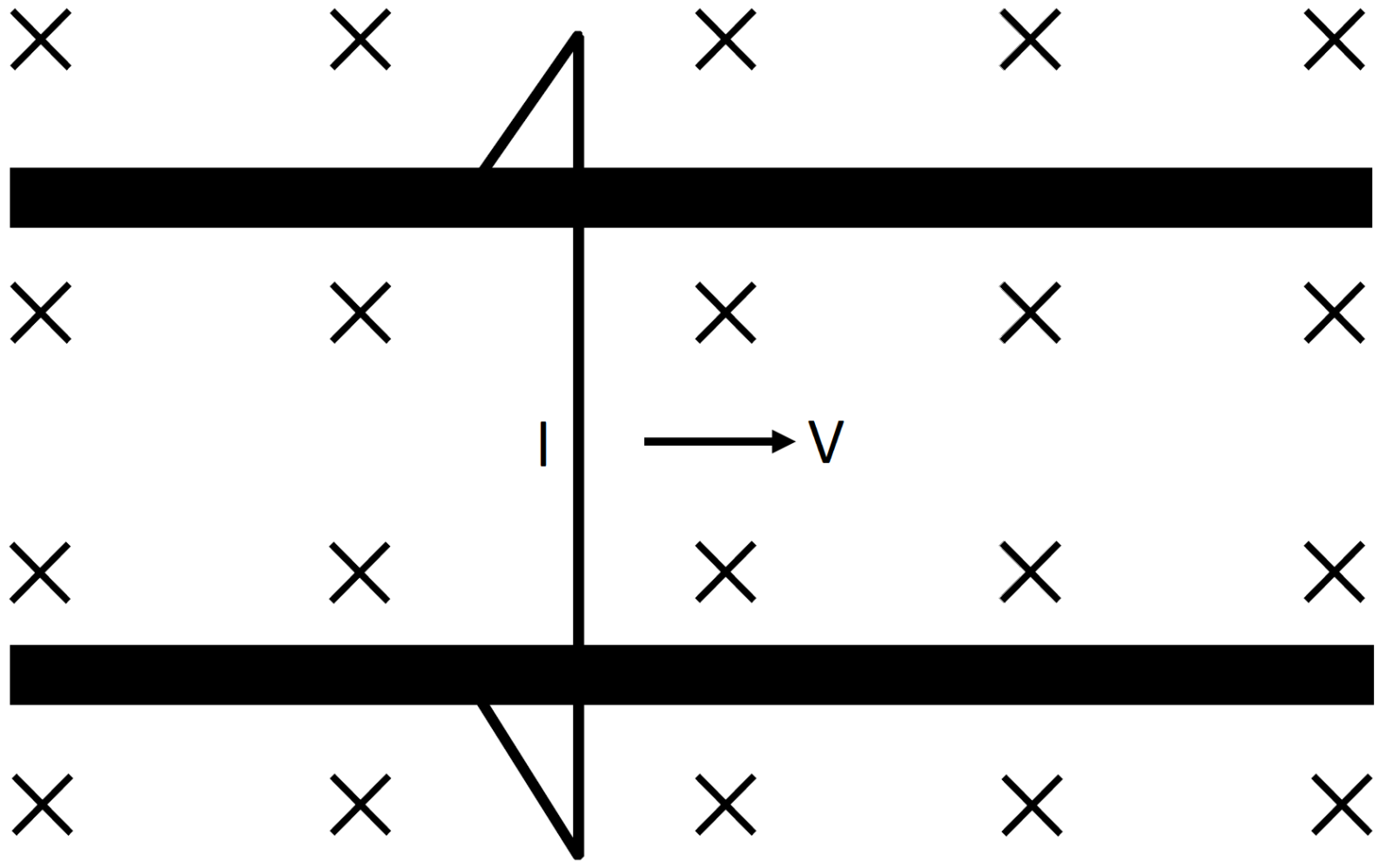
Figure shows a wire sliding on two parallel, conducting rails placed at a separation l. A magnetic field B exists in a direction perpendicular to the plane of the rails. What force is necessary to keep the wire moving at a constant velocity v?

An iron needle is attracted to the ends of a bar magnet but not to the middle region of the magnet. Is the material making up the ends of a bar magnet different from that of the middle region?
Find the maximum kinetic energy of the photoelectrons ejected when light of wavelength 350nm is incident on a cesium surface. Work function of cesium = 1.9eV
Taking force, length and time to be the fundamental quantities find the dimensions of:
  1. Density.
  2. Pressure.
  3. Momentum.
  4. Energy.
An electron gun emits 2.0 × 10¹⁶ electrons per second. What electric current does this correspond to?
A capacitor with capacitance C is changed to potential V. What is its electrical energy ?
A 100Ω resistor is connected to a 220V, 50Hz ac supply.
  1. What is the rms value of current in the circuit?
  2. What is the net power consumed over a full cycle?
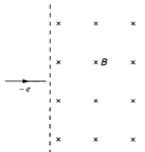
a. An electron moving horizontally with a velocity of $4 \times 10^4 m / s$ enters a region of uniform magnetic field of $10^{-5} T$ acting vertically upward as shown in the figure. Draw its trajectory and find out the time it takes to

Image

b. A straight wire of mass 200 g and length 1.5 m carries a current of 2 A. It is suspended in mid air by a uniform magnetic field B. What is the magnitude of the magnetic field?
A 44 m H inductor is connected to 220 V, 50 Hz ac supply. Determine the rms value of the current in the circuit.