Question
Explain how the electron was historically discovered.

Answer


Image
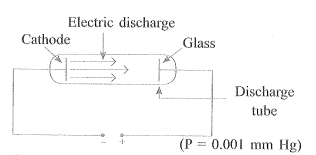
→0.001 mm Hg pressure (a pressure equal to a column of mercury 0.001 mm high) is applied to the discharge tube. Now applying a sufficient electric field between the two electrodes produces an electric discharge in the tube.
→A fluorescent glow is produced on the glass opposite to cathode.
→The colour of glow of the lamp depends on the type of glass, for example a yellowish-green colour appears on soda glass.
→The reason of this fluorescence was attributed to the radiation which comes from the cathode, called cathode rays. It was discovered by William Crookes.
→He suggested that cathode rays are made up of fast moving negatively charged particles.
• J. J. Thomson's work
→J. J. Thomson calculated the particle speed and specific charge (charge to mass ratio) $\frac{e}{m}$ of these cathode ray by applying mutually perpendicular electric and magnetic fields to the discharge tube.
→According to this calculation the speed of these particles is 0.1 to 0.2 times the speed of light in vacuum and the value of $\frac{e}{m}$ is $1.76 \times 10^{11} \frac{ C }{ kg }$.
→The value of $\frac{e}{m}$ does not depend on the metal/ material used as the cathode or on the gas contained in the discharge tube.
→When some metals irradiated by ultraviolet light, they emitted negatively charged particles having less speeds. In addition when some metals heated to a high temperature also produce similar particles.
→The particles produced in each of these cases have the same value of $\frac{e}{m}\left(1.76 \times 10^{11} \frac{ C }{ kg }\right)$.
→Thus, J. J. Thomson stated that the particles produced in each of these events are fundamental (elementry) particles, which he named electrons.

Need a full question paper?

Generate a complete, print-ready paper with questions like this in minutes — across 16+ boards, with answer keys.
Start Generating Free

Similar questions

A $100W$ sodium lamp radiates energy uniformly in all directions. The lamp is located at the centre of a large sphere that absorbs all the sodium light which is incident on it. The wavelength of the sodium light is $589\ nm.$
  1. What is the energy per photon associated with the sodium light?
  2. At what rate are the photons delivered to the sphere?
Can two particles be in equilibrium under the action of their mutual gravitational force? Can three particles be? Can one of the three particles be?
Prove that $I _{ D }=\epsilon_0 \frac{d}{d t}\left(\phi_{ E }\right)$, when symbols have their usual meanings.
A small telescope has an objective lens of focal length 144 cm and an eyepiece of focal length 6.0 cm. What is the magnifying power of the telescope? What is the separation between the objective and the eyepiece?
A 12.3 eV electron beam is used to bombard gaseous hydrogen at room temperature. Upto which energy level the hydrogen atoms would be excited?
Calculate the wavelengths of the second member of Lyman series and second member of Balmer series.
  1. Describe briefly the functions of the three segments of $\text{n-p-n}$ transistor.
  2. Draw the circuit arrangement for studying the output characteristics of $\text{n-p-n}$ transistor in $CE$ configuration. Explain how the output characteristics is obtained.
Which wavelengths will be emitted by a sample of atomic hydrogen gas (in ground state) if electrons of energy 12.2eV collide with the atoms of the gas?
A network of four $10 \mu F$ capacitors is connected to a $500 V$ supply, as shown in Fig. $2.29$. Determine $(a)$ the equivalent capacitance of the network and $(b)$ the charge on each capacitor. $($Note, the charge on a capacitor is the charge on the plate with higher potential, equal and opposite to the charge on the plate with lower potential.$)$
Image
Obtain the de Broglie wavelength associated with thermal neutrons at room temperature $(27^\circ C).$ Hence explain why a fast neutron beam needs to be thermalised with the environment before it can be used for neutron diffraction experiments.
Assume that each atom in a copper wire contributes one free electron. Estimate the number of free electrons in a copper wire having a mass of $6.4g\ ($take the atomic weight of copper to be $64g\ mol^{-1}.$