Question
Explain how the electron was historically discovered.

Answer


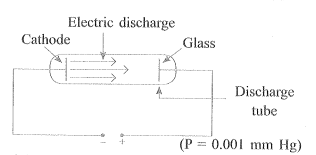
Image
→0.001 mm Hg pressure (a pressure equal to a column of mercury 0.001 mm high) is applied to the discharge tube. Now applying a sufficient electric field between the two electrodes produces an electric discharge in the tube.
→A fluorescent glow is produced on the glass opposite to cathode.
→The colour of glow of the lamp depends on the type of glass, for example a yellowish-green colour appears on soda glass.
→The reason of this fluorescence was attributed to the radiation which comes from the cathode, called cathode rays. It was discovered by William Crookes.
→He suggested that cathode rays are made up of fast moving negatively charged particles.
• J. J. Thomson's work
→J. J. Thomson calculated the particle speed and specific charge (charge to mass ratio) $\frac{e}{m}$ of these cathode ray by applying mutually perpendicular electric and magnetic fields to the discharge tube.
→According to this calculation the speed of these particles is 0.1 to 0.2 times the speed of light in vacuum and the value of $\frac{e}{m}$ is $1.76 \times 10^{11} \frac{ C }{ kg }$.
→The value of $\frac{e}{m}$ does not depend on the metal/ material used as the cathode or on the gas contained in the discharge tube.
→When some metals irradiated by ultraviolet light, they emitted negatively charged particles having less speeds. In addition when some metals heated to a high temperature also produce similar particles.
→The particles produced in each of these cases have the same value of $\frac{e}{m}\left(1.76 \times 10^{11} \frac{ C }{ kg }\right)$.
→Thus, J. J. Thomson stated that the particles produced in each of these events are fundamental (elementry) particles, which he named electrons.

Need a full question paper?

Generate a complete, print-ready paper with questions like this in minutes — across 16+ boards, with answer keys.
Start Generating Free

Similar questions

What is obtained by fusion of two deuterons?
Using Bohr’s postulates, obtain the expression for the total energy of the electron in the stationary states of the hydrogen atom. Hence draw the energy level diagram showing how the line spectra corresponding to Balmer series occur due to transition between energy levels.
A thin but long, hollow, cylindrical tube of radius r carries a current i along its length. Find the magnitude of the magnetic field at a distance $\frac{\text{r}}{2}$ from the surface (a) inside the tube (b) outside the tube.
Figure 1.33 shows tracks of three charged particles in a uniform electrostatic field. Give the signs of the three charges. Which particle has the highest charge to mass ratio?

  1. Describe the working of photodiode by drawing the circuit diagram.
  2. Draw the characteristics of a photodiode for different illumination intensities.
  3. Why is photodiode operated in reverse bias even though the reverse bias current is much weaker than the current in forward bias?
An inductor 200mH, a capacitor $100\mu\text{F}$ and a resistor $10\Omega$ are connected in series to an a.c. source of 100V, having variable frequency.
  1. At what frequency of the applied voltage will the power factor of the circuit be 1?
  2. What will be the current amplitude at this frequency?
  3. Calculate the Q-factor of the circuit.
A person standing on a road sends a sound signal to the driver of a car going away from him at a speed of 72km/h. The signal travelling at 330m/s in air and having a frequencyof 1600Hz gets reflected d from the body of the car and returns. Find the frequency of the reflected signal as heard by the person.
Two heating elements of resistances Rand Rwhen operated at a constant supply of voltage, V, Consume power P1 and P2  respectively. Deduce the expressions for the power of their combination when they are, in turn, connected in (i) series and (ii) parallel across the same voltage supply.
In an experiment on photoelectric effect, the slope of the cut-off voltage versus frequency of incident light is found to be 4.12 × 10–15 Vs. Calculate the value of Planck’s constant.
A particle of mass in is attatched to three springs A, B and C of equal force constants k as shown in figure If the particle is pushed slightly against the spring C and released, find the time period of oscillation.