DUAL NATURE OF RADIATION AND MATTER — Physics STD 12 Science — Question
Bihar BoardEnglish MediumSTD 12 SciencePhysicsDUAL NATURE OF RADIATION AND MATTER3 Marks
Question
Explain how the electron was historically discovered.
✓
Answer
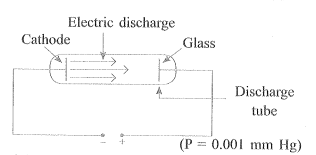
→0.001 mm Hg pressure (a pressure equal to a column of mercury 0.001 mm high) is applied to the discharge tube. Now applying a sufficient electric field between the two electrodes produces an electric discharge in the tube. →A fluorescent glow is produced on the glass opposite to cathode. →The colour of glow of the lamp depends on the type of glass, for example a yellowish-green colour appears on soda glass. →The reason of this fluorescence was attributed to the radiation which comes from the cathode, called cathode rays. It was discovered by William Crookes. →He suggested that cathode rays are made up of fast moving negatively charged particles. • J. J. Thomson's work →J. J. Thomson calculated the particle speed and specific charge (charge to mass ratio) $\frac{e}{m}$ of these cathode ray by applying mutually perpendicular electric and magnetic fields to the discharge tube. →According to this calculation the speed of these particles is 0.1 to 0.2 times the speed of light in vacuum and the value of $\frac{e}{m}$ is $1.76 \times 10^{11} \frac{ C }{ kg }$. →The value of $\frac{e}{m}$ does not depend on the metal/ material used as the cathode or on the gas contained in the discharge tube. →When some metals irradiated by ultraviolet light, they emitted negatively charged particles having less speeds. In addition when some metals heated to a high temperature also produce similar particles. →The particles produced in each of these cases have the same value of $\frac{e}{m}\left(1.76 \times 10^{11} \frac{ C }{ kg }\right)$. →Thus, J. J. Thomson stated that the particles produced in each of these events are fundamental (elementry) particles, which he named electrons.
Need a full question paper?
Generate a complete, print-ready paper with questions like this in minutes — across 16+ boards, with answer keys.