Question
Explain how the process of a basic idea becoming an opportunity?
OR
Explain the transformation of ideas into opportunity.
Answer

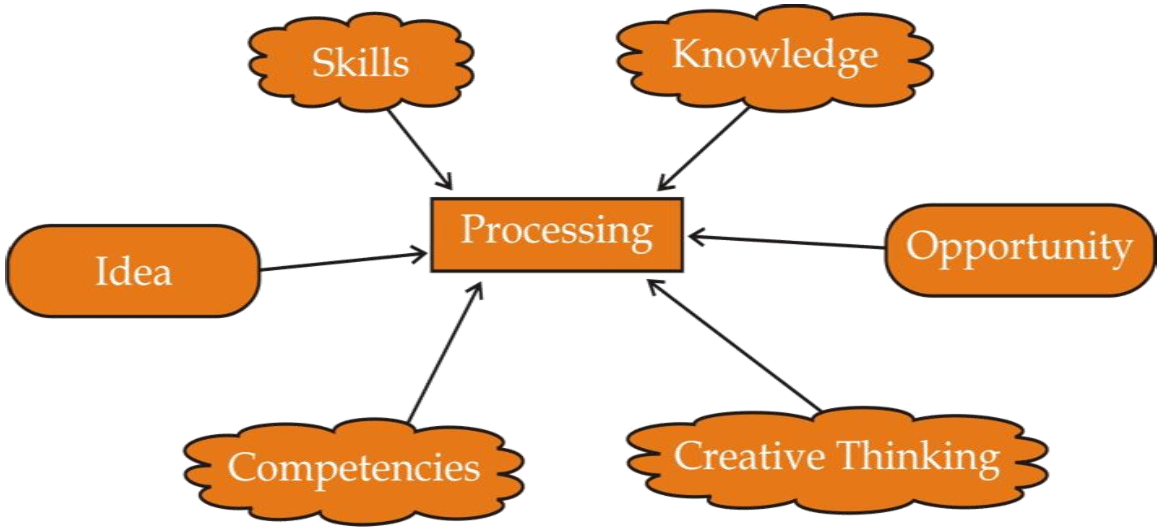
The given diagram shows how the process of a basic idea becoming an opportunity:

The above given diagram explains that it is just a process of conversion of basic idea into opportunity. Business idea arises from an opportunity in the market. It originates from any need or wants of any product or services that an entrepreneur can identify. In this process all basic ideas have to undergo a vigorous process of close examination, evaluation, analysis and synthesis to become viable opportunities. This diagram explains an entrepreneur utilize the skills, knowledge, creative thinking and competency needed to develop an idea which is backed up by various political economical, social, technological, ecological and legal factors in the existing competitive market. By this process an entrepreneur convert ideas into viable business opportunities.

Need a full question paper?

Generate a complete, print-ready paper with questions like this in minutes — across 16+ boards, with answer keys.

Start Generating Free

Similar questions

Raghav, an entrepreneur realises that the enterprise he wants to start, has a potential risk of fire accidents because the production process poses such a threat. Should he develop strategies to:
  1. Prevent the risk.
  2. Respond to the risk.
  3. Prevent as well as respond to the risk? Give reasons.
‘Flavouright Foods Ltd.’ started a business of making nachos (corn chips) in three variants, Classic Cheese, Toasted Corn and Tangy Tomato. To start with, all the three variants will be sold in a standard packing of 100 gms each, the selling price would differ due to the ingredients used. Fixed costs are ₹ 38,000.
Sales price and variable costs per unit are as follows:
Particulars Classic Cheese Toasted Corn Tangy Tomato
Sales Price ₹ 80 45 60
Variable Cost ₹ 40 15 20
Packets sold 100 40 60
From the above information calculate:
  1. Weighted contribution margin per unit.
  2. Breakeven point–total and per product.
How does market demand influence a business idea? Give a suitable example.
Harsh has come up with a innovative idea of school bags. He believes that this can bring a new way of thought in the minds of consumers with respect to school bags. He want to start the production of bags by setting up SSI in the industrial area. He should contact which financial institute for assistance in opening his innovative venture. Write the features of this financial institution.
Explain how 'Application and Use', 'Level of operation', 'Cost' and 'Technical complexity' help in identifying a feasible product or process.
Radhika after graduating from college went back to her home town in Meghalaya. It was a small town with very few job opportunities. The Karbi tribal women in that area were uneducated but still practiced the method of obtaining traditional colours from natural wild herbs. Their most popular dye was indigo obtained from the leave called 'sibu'. Using these colours, they added variety to their textiles. The women were mainly confined to their homes and they did not know how to make a living out of their talent. Shiela went from door to door analysed the problem that existed. She thought of setting up a voluntary association of rural women who would be able to join and leave the organisation at their own will without any coercion or intimidation.
  1. Name the process which helped Shiela in converting an idea into an opportunity.
  2. Identify the kind of organisation that Shiela has decided to set-up.
  3. State any two values which Shiela wants to communicate to the society.
Manohar and Manav were running a partnership firm. The firm is engaged in the production and marketing of edible oils. Manohar was looking after the production and Manav used to look after the remaining operations of the business. The firm was doing good business and earning profits more than the rate of profit of the industry. They used to be fair in their dealings with the customers and other stakeholders of the business. They used to do their quantitative planning meticulously. The edible oil produced by the firm is as per the fssai Standards.
  1. Explain any one type of plan prepared each by Manohar and Manav with quantitative expressions.
  2. Identify any two values observed by Manohar and Manav.
Answer each of these questions in about one hundred and fifty words:
Write a short note on IIBI.
A factory is engaged in manufacturing coolers. The following information is available to you: Sales = ₹ 2,50,000 Direct labour cost (for 100 units) = ₹ 25,000 Direct material cost (for 100 units) =₹ 62,500 Direct expenses (for 100 units) = ₹ 12,500 Fixed cost = 75,000Calculate:
  1. Variable cost per unit.
  2. Total cost.
  3. Break-even point.
Are actual sales exceeding the sales required to break-even? If yes, then what values are exhibited by the business in achieving those sales?
Answer each of these questions in about one hundred and fifty words:
What is synergy? In what forms can it take place?