Question
Explain how the specific heat capacity of a solid can be determined (measured) by the method of mixture.
Now, heat lost by the solid $(Q)=$ mass of the solid $\times$ its specific heat capacity $\times$ decrease in its temperature, heat gained by the water $\left(Q_1\right)=$ mass of the water $\times$ its specific heat capacity $\times$ increase in its temperature and heat gained by the calorimeter $\left(Q_2\right)=$ mass of the calorimeter $\times$ its specific heat capacity $\times$ increase in its temperature.
Heat lost by the hot object = heat gained by the calorimeter + heat gained by the water. $Q = Q _2+ Q _1$
Using this equation, the specific heat capacity of the solid can be determined (measured) when the other quantities are known.
Generate a complete, print-ready paper with questions like this in minutes — across 16+ boards, with answer keys.
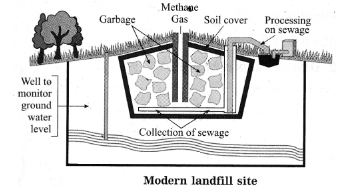
(a) Name the following method of solid waste management.
(b) What type of waste is used in this method?
(c) What kind of useful substances can be obtained from such methods?