Question
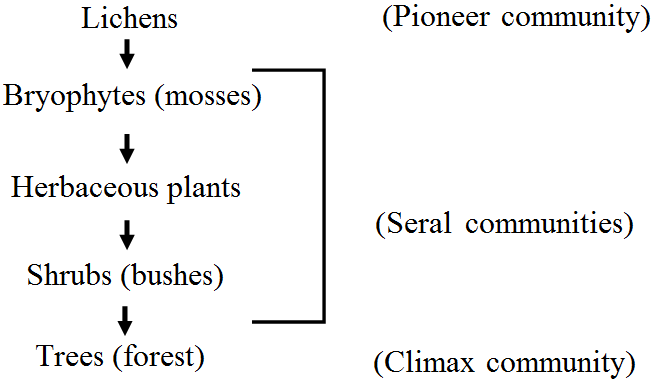
Explain how xerarch succession progresses from serie to mesic condition and forms a stable climax community. You may use a flow chart.
Answer

Xerarch succession:

  1. In the primary xerarch succession, lichens are the pioneer species; they secrete acids to dissolve the rock, facilitating weathering and soil formation.
  2. With formation of soil, small plants like bryophytes occupy the area.
  3. They are succeeded by bigger plants over a long period of time. After several more seral stages, a stable climax forest community is formed.
  4. The climax community remains stable as long as the environment remains unchanged.
  5. The xeric habitat is changed into a mesic habitat.


Need a full question paper?

Generate a complete, print-ready paper with questions like this in minutes — across 16+ boards, with answer keys.

Start Generating Free

Similar questions

List 10 modern-day animals and using the internet resources link it to a corresponding ancient fossil. Name both.
With a neat, labelled diagram, describe the parts of a typical angiosperm ovule.
Answer the following questions:
Four children with four different blood groups are born to parents where the mother has blood group ‘A’ and the father has blood group ‘B’. Work out the cross to show the genotypes of the parents and all four children.
What do you understand by semi conservative method of Replication. Describe with diagram the experiment done by Masselson and Stahl to prove semiconservative replication in DNA.
Why do some adolescents start taking drugs? How can the situation be avoided?
Differentiate between microsporogenesis and megasporogenesis. Which type of cell division occurs during these events? Name the structures formed at the end of these two events.
Match the codons in Column I with the amino acids in Column II.
S. No.
Column I
 
Column II
A
UUU
1
Termination
B
AUG
2
Tyrosine
C
UAA
3
Phenylalanine
D
AGU
4
Methionine
E
UAC
5
Serine
Study the table given below and answer the questions that follow:
Species A
Species B
Name of interaction
(+)
(+)
(A)
(-)
(-)
(b)
(+)
(-)
(c)
(+)
(0)
(d)
+ = Beneficial interaction
- = Detrimental interaction
0 = Neutral interaction
Identify a, b, c and d in the given table and explain any three of them with the help of an example each.
In a pond, we see plants which are free-floating; rooted–submerged; rooted emergent; rooted with floating leaves. Write the type of plants against each of them.
 
Plant Name
Type
a.
Hydrilla
____________
b.
Typha
____________
c.
Nymphaea
____________
d.
Lemna
____________
e.
Vallisnaria
____________
Read the following and answer any four questions from (i) to (v) given below:

Stem cells hold the potential for manifold applications in biotechnology based next generation therapeutics. Scientists are trying to formulate better and more personalised treatment modalities against some seemingly irremediable diseases, by harnessing body's own stem cells and stem cell niche. Stem cells of different origin and level of potency are being investigated for tissue regeneration, treatment of bone defect, drug testing, gene therapy and cell based therapy for muscle damage, spinal cord injury, cancer therapy, etc. 'Tile properties of embryonic and adult stem cells to either self-renew or differentiate into multiple cell lineages make them an attractive source for cell therapies, tissue engineering and as model system for drug screening.

  1. Stem cells are widely used in medical research. Which property of stem cells makes them particularly useful in this research?
  1. They can be fused together to form a zygote.
  2. They can divide and eventually give rise to a whole organism.
  3. They can divide and be made to differentiate into various types of cell.
  4. They will continue to divide indefinitely.
  1. Stem cells can be divided into four main types. Which of the four types of stem cell can differentiate into a limited range of tissues?
  1. Adult stem cells.
  2. Embryonic stem cells.
  3. Fetal stem cells.
  4. Zygotic stem cells.
  1. Which feature of stem cells obtained from blood in the umbilical cord enables their use in the treatment of a variety of blood cancers?
  1. They can differentiate into bone marrow cells.
  2. They can differentiate into any cellular component of blood.
  3. They can replace blood stem cells affected by cancer.
  4. They are totipotent.
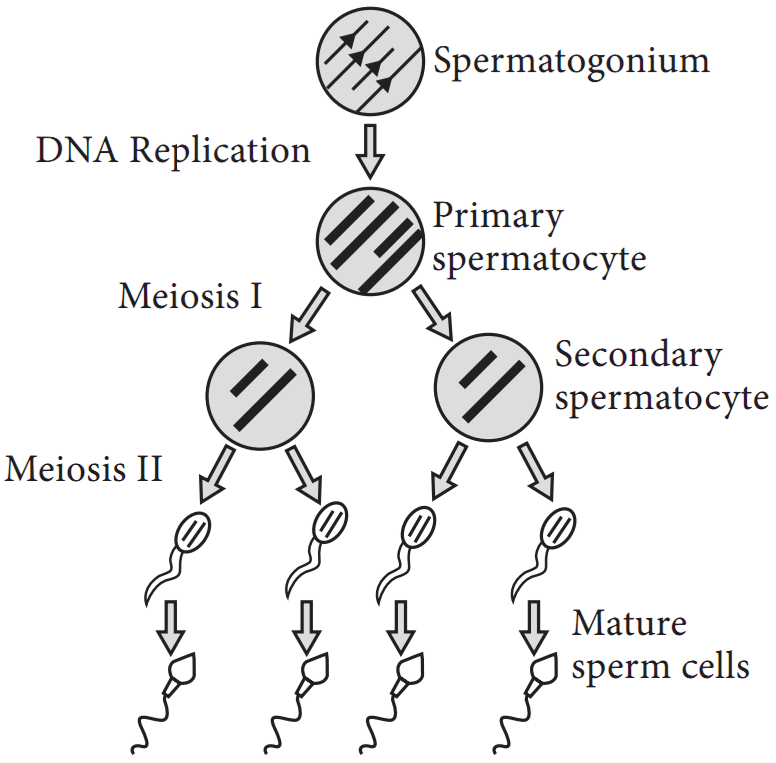
  1. The search for pluripotent stem cells is intense. The spennatogonium is the diploid precursor of haploid sperm in the development pathway of mouse gametes as shown below.

Scientists were interested to find out which stages of sperm development have stem cell capacity. Two experiments were carried out using sterile host males with testes that lacked germ cells. The results are shown in the table.

  Type of cells used Result
Experiment 1 Secondary spermatocytes were injected Fertility was not restored
Experiment 2 Spermatogonia were injected Fertility was restored for the rest of the mouse's life

What property of a stem cell is missing in the secondary spermatocytes?
  1. Specialisation.
  2. Self-renewal.
  3. Commitment.
  4. A proper stem-cell niche.
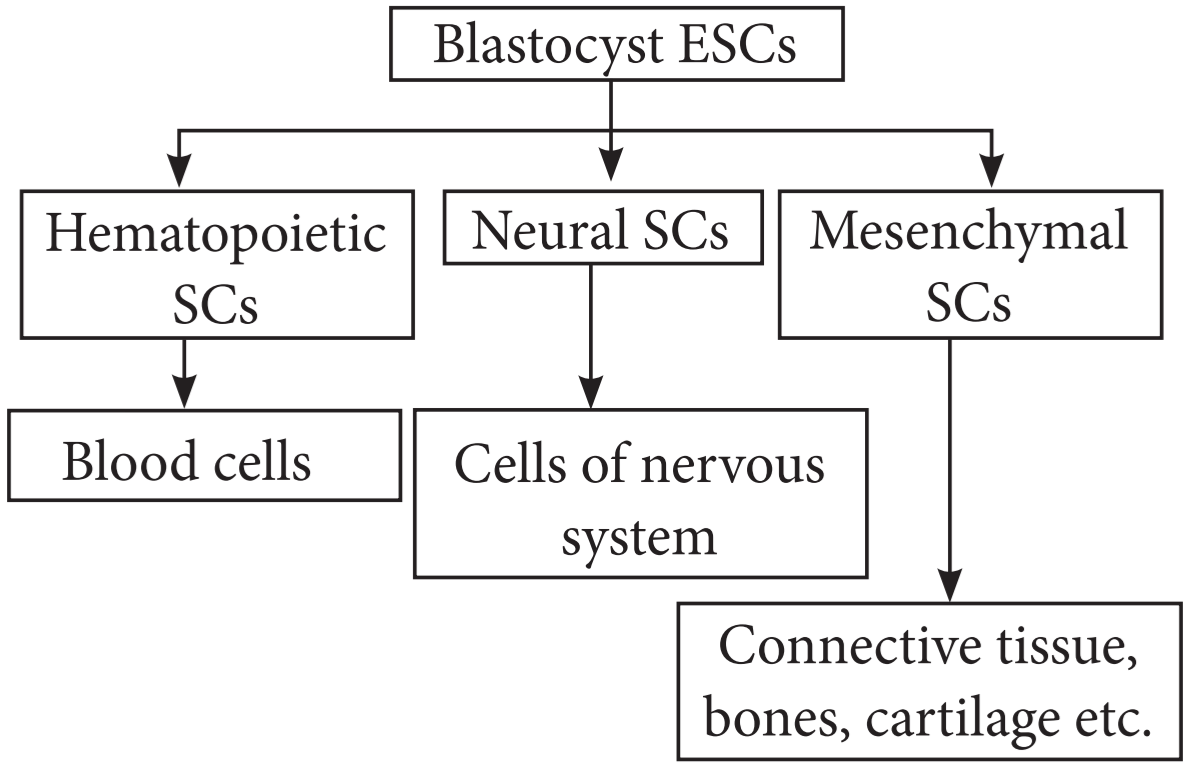
  1. Which feature of embryonic stem cells (ESCs) is illustrated below?

  1. ESCs are capable of dividing.
  2. ESCs are multipotent.
  3. ESCs are pluripotent.
  4. ES Cs show plasticity.