Question
Explain in brief with one example:
a. Ionic bond
b. covalent bond
c. co-ordinate bond
Answer

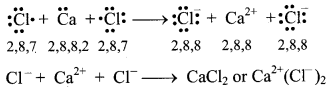
a. Formation of calcium chloride $\left( CaCl _2\right)$ :
i. The electronic configurations of calcium and chlorine are:
$Na ( Z =11): 1 s^2 2 s^2 2 p ^6 3 s^2 3 p ^6 4 s^2$ or $(2,8,8,2)$
$Cl ( Z =17): 1 s^2 2 s^2 2 p ^6 3 s^2 3 p ^5$ or $(2,8,7)$
ii. Calcium has two electrons in its valence shell. It has tendency to lose two electrons to acquire the electronic configuration of the nearest inert gas, argon ( $2,8,8$ ).
iii. Chlorine has seven electrons in its valence shell. It has tendency to gain one electron and thereby acquire the electronic configuration of the nearest inert gas, argon $(2,8,8)$.
iv. During the combination of calcium and chlorine atoms, the calcium atom transfers its valence electrons to two chlorine atoms.
v. Calcium atom changes into $Ca ^{2+}$ ion while the two chlorine atoms change into two $Cl ^{-}$ions. These ions are held together by strong electrostatic force of attraction.
vi. The formation of ionic bond(s) between Ca and Cl can be shown as follows:Image
b. Formation of $Cl _2$ molecule:
i. The electronic configuration of Cl atom is $[ Ne ] 3 s^2 3 p^5$.
ii. It needs one more electron to complete its valence shell.
iii. When two chlorine atoms approach each other at a certain internuclear distance, they share their valence electrons. In the process, both the atoms attain the valence shell of octet of nearest noble gas, argon. iv. The shared pair of electrons belongs equally to both the chlorine atoms. The two atoms are said to be linked by a single covalent bond and a $Cl _2$ molecule is formed.
Image
c. co-ordinate bond:
i. A coordinate bond is a type of covalent bond where both of the electrons that form the bond originate from the same atom
ii. An atom with a lone pair of electrons (non-bonding pair of electrons) is capable of forming a coordinate bond.
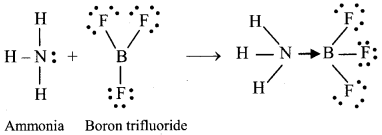
iii. For example, reaction of ammonia with boron trifluoride: Before the reaction, nitrogen $( N )$ in ammonia has eight valence electrons, including a lone pair of electrons. Boron (B) in boron trifluoride has only six valence electrons, so it is two electrons short of an octet. The two unpaired electrons form a bond between nitrogen and boron, resulting in complete octets for both atoms. A coordinate bond is represented by an arrow. The direction of the arrow indicates that the electrons are moving from nitrogen to boron. Thus, ammonia forms a coordinate bond with boron trifluoride.
Image

Need a full question paper?

Generate a complete, print-ready paper with questions like this in minutes — across 16+ boards, with answer keys.

Start Generating Free