Question
Explain isotopes, isobars, isotones and isomers by giving examples.

Answer

→ (i) Isotopes :
 The atoms which have atomic number Z same but atomic mass number A different, then such type of atoms are called the isotopes of each other.
For example :
Isotopes of hydrogen are ${ }_1 H ^1,{ }_1 H ^2,{ }_1 H ^3$
•${ }_1 H ^1$ - there is one proton but having no neutron.
• ${ }_1 H ^2$ - there is one proton one neutron.
• ${ }_1 H ^3$ - there is one proton and two neutrons.
Isotopes of carbon are ${ }_6 C ^{12},{ }_6 C ^{13},{ }_6 C ^{14}$
Isotopes of uranium are ${ }_{92} U ^{233},{ }_{92} C ^{235},{ }_{92} C ^{238}$
→ (ii) Isobar :
Atoms having same atomic mass number A , but different atomic number Z are called the isobars of each other.
→ For example :
${ }_1 H ^3$ and ${ }_2 He ^3$
${ }_{82} Pb^{214}$ and ${ }_{83} Bi ^{214}$
(iii) Isotone :
The atoms for which the neutron number N is the same but atomic number Z and mass number A are different are called isotones to each other.
For example :
${ }_{80} Hg ^{198} \text { and }{ }_{79} Au ^{197}$
→ (iv) Isomer :
→The atoms for which the atomic number Z and mass number A are same but their radioactive properties are different are called isomers of each other.
→For example :
${ }_{35} Br ^{80}$ contains a pair of isomers.

Need a full question paper?

Generate a complete, print-ready paper with questions like this in minutes — across 16+ boards, with answer keys.
Start Generating Free

Similar questions

What is meant by nuclear mass defect?
Derive the formula of electric field for a point on the axis of electric dipole.
Identify the following electromagnetic radiations as per the wavelengths given below.
  1. 10-3nm
  2. 10-3m
  3. 1nm
Write one application of each.
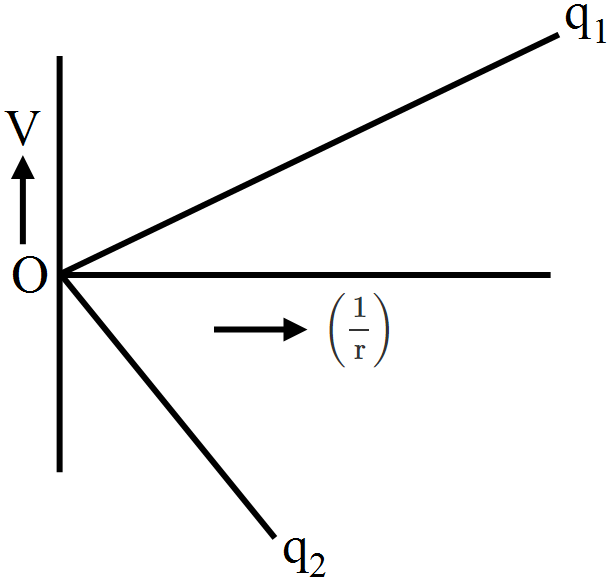
The two graphs are drawn below, show the variations of electrostatic potential (V) $\frac{1}{\text{r}}$ (r being the distance of field point from the point charge) for two point charges q1 and q2.
  1. What are the signs of the two charges?
  2. Which of the two charges has the larger magnitude and why?
​​​​​​​​​​​​​​
A charge of $20\mu\text{C}$ is placed on the positive plate of an isolated parallel-plate capacitor of capacitance $10\mu\text{F}.$ Calculate the potential difference developed between the plates.
Consider a non-conducting ring of radius r and mass m that has a total charge q distributed uniformly on it. The ring is rotated about its axis with an angular speed $\omega.$
  1. Find the equivalent electric current in the ring.
  2. Find the magnetic moment $\mu$ of the ring.
  3. Show that $\mu=\frac{\text{q}}{2\text{m}}\text{l}$ where l is the angular momentum of the ring about its axis of rotation.
  1. Draw the energy level diagram showing the emission of b-particles followed by γ-rays by a $\text{ }^{60}_{27}\text{Co}$ nucleus.
  2. Plot of distribution of KE of b-particles is shown in fig. (b).


  1. A rod of length l is moved horizontally with a uniform velocity ‘v’ in a direction perpendicular to its length through a region in which a uniform magnetic field is acting vertically downward. Derive the expression for the emf induced across the ends of the rod.
  2. How does one understand this motional emf by invoking the Lorentz force acting on the free charge carriers of the conductor? Explain.
A beam of light converges to a point P. A lens is placed in the path of the convergent beam12 cm from P. At what point does the beam converge if the lens is.
  1. a convex lens of focal length 20 cm,
  2. a concave lens of focal length 16 cm?
Do the required calculations.
A parallel-plate capacitor with plate area 20cm2 and plate separation 1.0mm is connected to a battery. The resistance of the circuit is $10\text{k}\Omega.$ Find the time constant of the circuit.