Question
Explain logistic growth with equation.
Answer

→ No population of any species in nature has at its disposal unlimited resources to permit exponential growth.
→ This leads to competition between individuals for limited resources.
→ Eventually, the 'fittest' individual will survive and reproduce.
→ The governments of many countries have also realised this fact and introduced various restraints with a view to limit human population growth.
→ In nature, a given habitat has enough resources to support a maximum possible number, beyond which no further growth is possible.
→ This limit is nature's carrying capacity (K) for that species in that habitat.
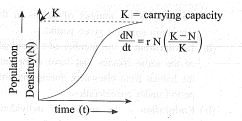
→ A population growing in a habitat with limited resources show initially a lag phase, followed by phases of acceleration and deceleration and finally an asymptote, when the population density reaches the carrying capacity.
→ A plot of N in relation to time (t) results in a sigmoid curve. This type of population growth is called Verhulst-Pearl Logistic Growth.
Image
→ The Verhulst-Pearl Logistic Growth equation :
$
dN / dt = rN ( K - N / K )
$
Where $N =$ Population density at time t
$r =$ Intrinsic rate of natural increase
$K=$ Carrying capacity
→ Since resources for growth for most animal populations are finite and become limiting sooner or later, the logistic growth model is considered a more realistic one.
→ Gather from Government Census data the population figures for India for the last 100 years, plot them and check which growth pattern is evident.

Need a full question paper?

Generate a complete, print-ready paper with questions like this in minutes — across 16+ boards, with answer keys.

Start Generating Free

Similar questions

What is the function of bulbourethral glands?
Describe biopiracy.
Name two hormones that are constituents of contraceptive pills. Why do they have high and effective contraceptive value? Name a commonly prescribed non – steroidal oral pill.
Rearrange the following in the correct sequence to accomplish an important biotechnological reaction:
  1. In vitro synthesis of copies of DNA of interest,
  2. Chemically synthesised oligonucleotides,
  3. Enzyme DNA-polymerase,
  4. Complementry region of DNA,
  5. Genomic DNA template,
  6. Nucleotides provided,
  7. Primers,
  8. Thermostable DNA-polymers (From Thermus aquaticus),
  9. Denaturation of dsDNA.
Explain the role of baculoviruses as biological control agents. Mention their importance in organic farming.
  1. Expand VNTR and describe its role in DNA fingerprinting.
  2. List any two applications of DNA fingerprinting technique.
What does an interaction between pollen grains and its compatible stigma result in after pollination? List two steps in sequence that follow after the process.
Identify the odd one out in each of the following sets:
  1. Rete testis, vas deferens, isthmus, epididymis.
  2. Seminal vesicles, ampulla, prostate, bulbourethral glands.
Snapdragon shows incomplete dominance for flower colour. Work out across and explain the phenomenon. How is this inheritance different from Mendelian pattern of inheritance? Explain.

OR

In snapdragon (Antirrhinum majus), a plant with red flowers was crossed with a plant with white flowers. Work out all the possible genotypes and phenotypes of F1 and F2 generations. Comment on the pattern of inheritance in this case.

Explain DNA Polymorphism