Question
Explain Maslow's theory of motivation.

Answer

Maslow's Hierarchy of Needs Theory: This theory was proposed by Abraham Maslow and is based on the assumption that people are motivated by a series of five universal needs.
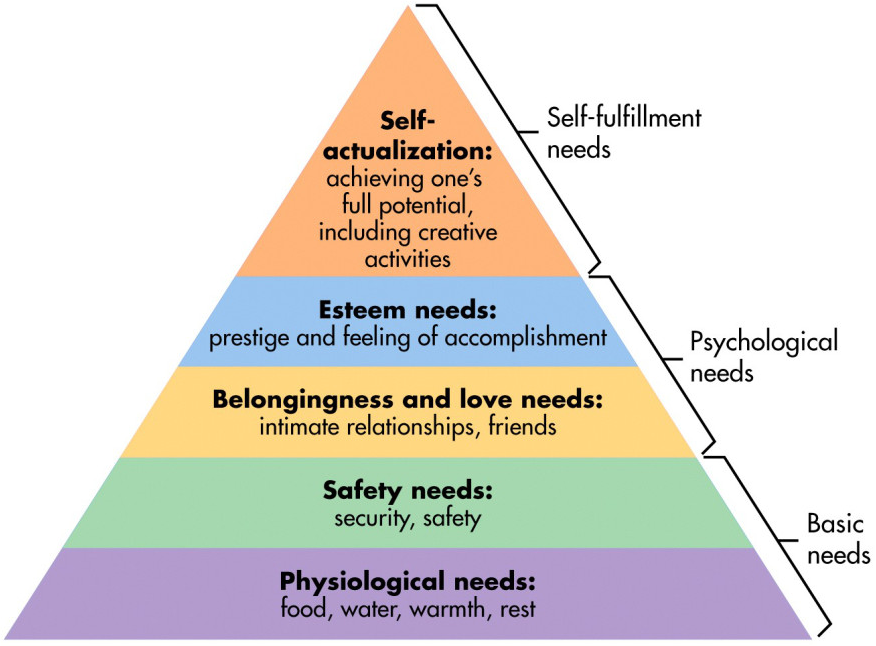
These needs are ranked, according to the order in which they influence human behaviour, in hierarchical fashion, as depicted below:
  1. Physiological needs: These needs are lowest in the pyramidical structure and are deemed to be the lowest level needs, such as the need for food and water. As long as physiological needs are unsatisfied, they exist as a driving or motivating force in a person's life.
A hungry person has a felt need. This felt need sets-up both psychological and physical tensions that manifest themselves in overt behaviours directed at reducing those tensions (getting something to eat).

Once the hunger is satisfied, the tension is reduced, and the need for food ceases to motivate. At this point (assuming that other physiological requirements are also satisfied), the next higher order need becomes the motivating need.
  1. Safety needs: These needs are second in the pyramidical structure and emerge only after the physiological needs are fulfilled.
These needs include a desire for security, stability, dependency, protection, freedom from fear and anxiety, and a need for structure, order and law. In the workplace, this need translates into a need for atleast a minimal degree of employment security, the knowledge that we cannot be fired on a whim and that appropriate levels of effort and productivity will ensure continued employment.
  1. Social needs: These needs rank third in the pyramidical structure and emerge after the safety needs have been fulfilled. These needs include the need for belongingness and love. Being social creatures, humans have a need to belong. In the workplace, this need may be satisfied by an ability to interact with one's co-workers and perhaps to be able to work collaboratively with their colleagues.
  2. Ego and esteem needs: These needs rank fourth in the pyramidical structure and emerge after the social needs have been fulfilled. Esteem needs include the desire for self-respect, self-esteem and the esteem of others. When focused externally, these needs also include the desire for reputation, prestige, status, fame, glory, dominance, recognition, attention, importance and appreciation.
  3. Self-actualisation needs: These needs rank the highest in Maslow's pyramidical structure and emerge after the satisfaction of ego and esteem needs. These needs comprise of the need for self-realisation, continuous self-development and the process of becoming all that a person is capable of.

Need a full question paper?

Generate a complete, print-ready paper with questions like this in minutes — across 16+ boards, with answer keys.

Start Generating Free

Similar questions

Differentiate between cottage industries and rural industries.
What is ‛Startup Cost‘? Identify the areas for requirement of Startup Cost.
Discuss any five innovations, which led to successful ventures.
Give the classification of entrepreneurs as given by Wagner.
Ms. Neerja, who runs a computer stationery store, has the following transactions. Please help her with the cashbook for her operations.On 1st of January, 2014, she has ₹ 22,500/- in cash and ₹ 40,000 in bank account.
(ii) On 5th January, 2014, she makes a cash sale of ₹ 19,500.
(iii) On 7th January, 2014, she receives a cheque for ₹ 16,000 from Excel Company for sales made in December
(iv) On 9th January, 2014, she buys CDs and pendrives and makes a cheque payment of ₹ 5,000.
(v) On 12th January, 2014, she makes cash payment of ₹ 25,000 for various stationery purchased.
(vi) On 17th January, 2014, she withdraws cash of 15,000 from her checking account.
(vii) On 18th January, 2014, she pays salary of ₹ 25,000 to her sales staff.
(viii) On 24th January, 2014, she pays the monthly rent of ₹ 12,500 by cheque.
(xi) On 29th January, 2014, she deposits ₹ 25,000 in her bank account.
Why is it desirous for a firm to grow and expand?
Shalini plans to set up a Printing Press in Ludhiana. She looks upto her cousin Amit, who is successfully running a similar unit in Jaipur, for all possible help, guidance and suggestions. What kind of mentoring is this?
Differentiate between Entrepreneurial functions and Managerial functions of an Entrepreneur?
Explain in detail three new forms of business which is created because of technological changes.
Distinguish between:
Fixed Cost and Variable Cost.