Question
Explain Maxwell distribution of molecular speed with necessary graph.

Answer

Gas is collection of tiny particles separated from one another by large empty spaces and moving randomly in all directions. In the inter course of their motion, they collide with one another and also with the walls of the container. Due to these collisions, the speed and the direction of motion of the molecules keep on changing. Although. it is not possible to find out the speeds of the individual molecules, yet from the probability considerations it has become possible to work out the distribution of the molecules.
This distribution is referred to as Maxwell-Boltzmann distribution
The distribution of speeds remains fairly constant at a particular temperature althought the individual speeds of the molecules can change.
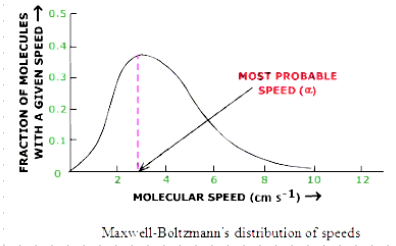
Maxwell plotted the fraction of molecules having different speed against the speeds at particular temperature. This plot is shown as follow:
Image
Improtant feature of this curve are:
The fraction of molecules with very low or high speeds is very small
The fraction of molecules possessing higher and higher speeds goes on increasing till it reaches a peak and then starts decreasing
The maximum fraction of molecules possesses a speed, corresponding to the peak in the curve which is referred to as most probable speed
The area under the curve gives the total number of gas molecules.

Need a full question paper?

Generate a complete, print-ready paper with questions like this in minutes — across 16+ boards, with answer keys.

Start Generating Free

Similar questions

The refractive indices of water for red and violet colours are 1.325 and 1.334 respectively. Find the difference between the velocities of rays for these two colours in water. \(\left( c =3 \times 10^8 m / s\right.\) )
A $10 H$ inductor carries a current of $25 A$. Flow much ice at $0{ }^{\circ} C$ could be melted by the energy stored in the magnetic field of the inductor? [Latent heat of fusion of ice, $L_f=335$ $J / g ]$
When the displacement in SHM is one-third of the amplitude, what fraction of the total energy is potential and what fraction is kinetic?
What is a ‘soft’ magnetic material?###What is meant by a ‘soft’ iron?
A certain string $500 \mathrm{~cm}$ long breaks under a tension of $45 \mathrm{~kg}$ wt. An object of mass $100 \mathrm{~g}$ is attached to this string and whirled in a horizontal circle. Find the maximum number of revolutions that the object can make per second without breaking the string, $\left[\mathrm{g}=9.8 \mathrm{~m} / \mathrm{s}^2\right.$ ]
A body of mass $1 kg$ is made to oscillate on a spring of force constant $16 N / m$. Calculate
(i) the angular frequency
(ii) the frequency of oscillation.
An electron in an atom revolves around the nucleus in an orbit of radius 0.53Å . If the frequency of revolution of an electron is \(9 \times 10^9 MHz\). Calculate the orbital angular momentum.
[Given : Charge on an electron \(=1.6 \times 10^{-19} C ;\) Gyromagnetic ratio \(=8.8 \times 10^{10} C / kg ; \pi=3.142\) ]
Suppose a dam is $250 \mathrm{~m}$ wide and the water is $40 \mathrm{~m}$ deep at the dam. What is
(i) the average pressure on the dam
(ii) the force exerted against the dam due to the water?
Explain back emf in a motor.
Two wires $12 m$ long and $10 \ cm$ apart carry the same current. Find the current through each wire if the force per unit length on each wire is $0.001\ N / m$.