→ The observation of Louis Pasteur (1848) th crystals of certain compounds exist in the form of mirror images laid the foundation of moder stereochemistry.
→ He demonstrated that aqueous solutions of both types of crystals showed optical rotation, equal in magnitude (for solution of equal concentration) but opposite in direction.
→ He believed that this difference in optical activity was associated with the three dimensional arrangements of atoms in the molecules (configurations) of two types of crystals.
→ Dutch scientist, J. Van't Hoff and French scientist, C. Le Bel in the same year (1874), independently argued that the spatial arrangement of four groups (valencies) around a central carbon is tetrahedral and if all the substituents attached to that carbon are different, the mirror image of the molecule is not superimposed (overlapped) on the molecule; such a carbon is called asymmetric carbon or stereocentre.
→ The resulting molecule would lack symmetry and is referred to as asymmetric molecule.
→ Chirality:
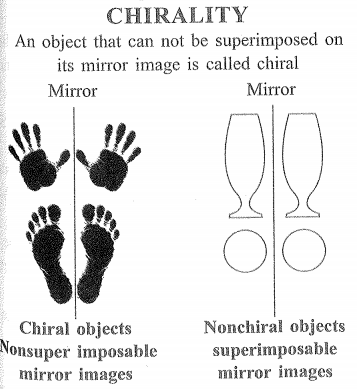
→ The symmetry and asymmetry are also observed in many day to day objects: a sphere, a cube, a cone, are all identical to their mirror images and can be superimposed.
→ However, many objects are non superimposable on their mirror images. For example, your left and right hand look similar but if you put your left hand on your right hand by moving them in the same plane, they do not coincide.
→ The objects which are non- superimposable on their mirror image (like a pair of hands) are said to be chiral and this property is known as chirality.
→ Chiral molecules are optically active, while the objects, which are, superimposable on their mirror images are called achiral. These molecules are optically inactive.
→ The above test of molecular chirality can be applied to organic molecules by constructing models and its mirror images or by drawing three dimensional structures and attempting to superimpose them in our minds.
→ Let us consider two simple molecules propan- 2-Ol and butan-2-Ol and their mirror images.
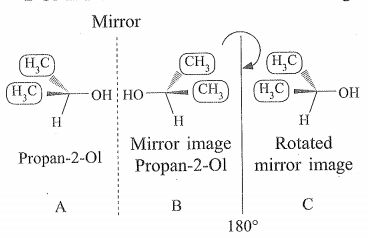
B is imrror image of A; B is rotated by 180° and C is obtained; C is superimposable on A
→ As you can see very clearly, propan-2-O1 (A) does not contain an asymmetric carbon, as all the four groups attached to the tetrahedral carbon are not different.
→ We rotate the mirror image (B) of the molecule by 180° (structure C) and try to overlap the structure (C) with the structure (A), these structures completely overlap. Thus propan-2-ol is an achiral molecule.
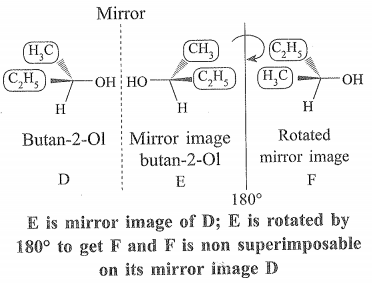
→ Butan-2-ol has four different groups attached to the tetrahedral carbon and as expected is chiral.
→ Some common examples of chiral molecules such as 2-chlorobutane, 2, 3-dihyroxypropanal, (OHC- CHOH-CH
2OH), bromochloro-iodomethane (BrCICHI), 2-bromopropanoic acid (H
3C-CHBr- COOH), etc.
→ The stereoisomers related to each other as non- superimposable mirror images are called enantiomers. A and B and D and E are enantiomers.
→ Enantiomers possess identical physical properties namely, melting point, boiling point, refractive index, etc.
→ They only differ with respect to the rotation of plane polarised light. If one of the enantiomer is dextro rotatory, the other will be laevo rotatory.