Question
Explain Mutualism as a population interaction with suitable examples.###Explain Mutualism with examples

Answer

→ This interaction confers benefits on both the interacting species.
Lichen : It is a mutualistic relationship between a fungus & photosynthesizing algae or cyanobacteria.
Mycorrhizae : Associations between fungi & the roots of higher plants. The fungi help the plant in the absorption of essential nutrients from the soil while the plant provides the fungi with carbohydrates.
Mutualism between plant & animal through pollination and seed dispersion :
Examples :
(1) Fig trees & wasps : The fig species is pollinated only by its 'partner' wasp species.
→ Female wasp pollinates the fig inflorescence  while searching for suitable egg-laying sites in fruits.
→ The fig offers the wasp some developing seeds, as food for the wasp larvae.
(2) Orchids : show diversity of floral patterns. They can attract the right pollinator insect (bees & bumblebees) to ensure pollination. Not all orchids offer rewards.
(3) 'Sexual deceit of Ophrys :  (Mediterranean orchid). One petal of its flower resembles female bee in size, colour & markings.
→ So male bee 'pseudocopulates' with the flower and is dusted with pollen. When this bee 'pseudocopulates' with another flower, it transfers pollen to it.
→ If the female bee's colour patterns change. slightly during evolution, pollination success will be reduced unless the orchid flower co- evolves to maintain the resemblance of its petal to the female bee.
Need a full question paper?

Generate a complete, print-ready paper with questions like this in minutes — across 16+ boards, with answer keys.

Start Generating Free

Similar questions

Read the following and answer any four questions from (i) to (v) given below:
The foundations of recombinant DNA (rDNA) were laid by the discovery of restriction enzymes. These enzymes are present in many bacterias where they function as a part of their defense mechanism called the Restriction Modification system (RM system). Molecular basis of this system was explained first by Werner Arber in 1962. The Restriction Modification system consists of two components:
  • A restriction enzyme (called restriction endonuclease) identifies the introduced foreign DNA and cuts it into pieces.
  • The second component is a modification enzyme (methylase) that adds a methyl group to DNA at specific site to protect it from the restriction enzyme cleavage.
  1. Restriction endonucleases are enzymes present in ________ where they function as a part of _______ mechanism.
  1. (i) bacteria (ii) digestive
  2. (i) protists (ii) transcription
  3. (i) plant cells (ii) replication
  4. (i) prokaryotes (ii) defence
  1. Which of the following statements regarding modification enzyme is correct?
  1. It adds methyl group to one or two bases usually within the host DNA sequence to protect it from the restriction enzyme.
  2. It adds ethyl group to one or two bases usually within the sequence recognised by the restriction enzymes.
  3. It adds methyl group to only one of bases within the foreign DNA sequence that is recognised by the restriction enzymes.
  4. None of these.
  1. Which of the following is a type II restriction enzyme?
  1. Alu I
  2. EcoR I
  3. BamH I
  4. All of these.
  1. Which of the following is the first discovered restriction endonuclease?
  1. Sal I
  2. EcoR I
  3. Hind II
  4. EcoR II
  1. Components of Restriction Modification System include?
  1. Restriction enzyme.
  2. Modification enzyme.
  3. Lysing enzyme.
  4. Both (a) and (b).
Read the following and answer any four questions from (i) to (v) given below:
The first menstruation is called menarche, that usually occurs between 12 and 15 years. In human females, menstruation is repeated at an average interval of about 28/29 days and is called menstrual cycle. It is regulated by certain hormones, as pituitary gland is stimulated by releasing factors produced in the hypothalamus. The hormones produced by pituitary gland influence the ovaries. The hormones secreted by the ovaries affect the walls of the uterus.
  1. The breakdown of endometrium is characteristic of:
  1. Proliferative phase.
  2. Luteal phase.
  3. Ovulatory phase.
  4. Menstrual phase.
  1. Which days of the menstrual cycle marks the proliferative phase?
  1. 1-5
  2. 15-28
  3. 6-13
  4. 10-14
  1. Which of the following occurs during secretory phase?
  1. Empty Graafian follicle changes into corpus luteum.
  2. Primary follicle changes into Graafian follicle.
  3. Endometrium rebuilds and estrogen secretion increases.
  4. LH surge, inducing release of an ovum.
  1. Identify the hormones that attain peak level during ovulatory phase.
  1. FSH.
  2. Progesterone.
  3. LH.
  4. Both (a) and (c).
  1. Withdrawal of which hormone causes degeneration of corpus luteum?
  1. FSH.
  2. LH.
  3. Progesterone.
  4. Estrogen.
Read the following and answer any four questions from (i) to (v) given below:

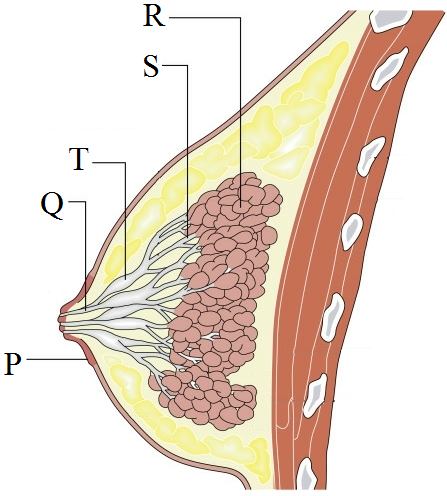
A functional mammary gland is characteristic of all female mammals. Mammary glands are paired structures that contain glandular tissue and variable amount of fat. Refer to the given figure of a mammary gland and answer the following questions.

  1. Mammary glands are modified:
  1. Sweat glands.
  2. Sebaceous glands.
  3. Sudoriferous glands.
  4. Lacrimal glands.
  1. Identify the incorrectly matched pair.
  1. P - Areola.
  2. Q - Lactiferous duct.
  3. S - Mammary duct.
  4. T - Mammary alveoli.
  1. Mammary ducts expand to form:
  1. Mammary alveoli.
  2. Mammary ampullae.
  3. Lactiferous ducts.
  4. Mammary tubules.
  1. What is areola?
  1. Grape-like clusters of milk secreting structures.
  2. Fatty tissue between the mammary lobes.
  3. Circular pigmented area of skin around nipple.
  4. Connective tissue that supports the alveoli and ducts.
  1. Assertion: The size of breast depends on the amount of adipose tissue.

Reason: The adipose tissue supports the alveoli and the ducts.

  1. Both assertion and reason are true, and reason is the correct explanation of assertion.
  2. Both assertion and reason are true, but reason is not the correct explanation of assertion.
  3. Assertion is true, but reason is false.
  4. Both assertion and reason are false.
Write a short note on endosperm development.
Define decomposition and describe the processes and products of decomposition.###Describe factor affecting decomposition.
Polymerase chain reaction:
  1. Is a method of synthesising human protein from human DNA
  2. Uses restriction enzymes
  3. Can produce billions of copies of a DNA fragment
  4. Takes place naturally in bacteria
Read the following and answer any four questions from (i) to (v) given below:

Oral administration of small doses of hormones is contraceptive method used by the females. They are used in the form of tablets and hence called the pills. The oral pills are two types; mini pills and combined pills.

  1. Mini pills contain:
  1. Estrogen only.
  2. Progestin only.
  3. Combination of progesterone-estrogen.
  4. Inhibin.
  1. How do hormonal pills prevent pregnancy?
  1. By phagocytosing the sperms.
  2. By inhibiting ovulation.
  3. By preventing sperms from entering the vagina.
  4. All of these.
  1. Pill containing non-steroidal preparation, centchroman is:
  1. Mala D.
  2. Mala N.
  3. I-Pill.
  4. Saheli.
  1. Which among the following is incorrect for oral contraceptives?
  1. Oral pills alter the uterine endometrium and make it unsuitable for implantation.
  2. Oral pills have to be taken daily for 7 days starting within first five days of menstrual cycle.
  3. Oral pills increase the risk of intravascular clotting.
  4. Oral pills contain either progestin alone or combination of progestogen and estrogen.
  1. Assertion: Mala D, a combined contraceptive pill, have to be taken daily without a break.

Reason: Mala D contains synthetic progesterone and estrogen.

  1. Both assertion and reason are true, and reason is the correct explanation of assertion.
  2. Both assertion and reason are true, but reason is not the correct explanation of assertion.
  3. Assertion is true, but reason is false.
  4. Both assertion and reason are false.
Write a short note on pollination by wind.
The bacterium Bacillus thuringiensis is widely used in contemporary biology as:
  1. Agent for production of dairy products.
  2. Source of industrial enzyme.
  3. Indicator of water pollution.
  4. Insecticide.
Read the following and answer any four questions from (i) to (v) given below:

Ginkgo tree has been saved from extinction by selective breeding followed by channeling into trade of nature lovers. This is an ex-situ conservation, where endangered species are protected from all adverse factors. Offspring produced in captive breeding are released in natural habitat for acclimatisation.

  1. What is the significance of offsite collections?
  1. Restock depleted populations.
  2. Protection of endangered species.
  3. Reintroduce species in wild.
  4. All of these.
  1. Which of the following is not an ex-situ conservation?
  1. Wetlands
  2. Orchards
  3. Aquaria
  4. Botanical gardens.
  1. Select the incorrect statements for ex-situ conservation.
  1. It is conservation of species outside their natural habitats.
  2. Endangered species are kept under human supervision and provided all the essentials.
  3. The species population recovers in natural environment.
  4. Both (b) and (c).
  1. Conditions maintained in seed banks for orthodox seeds are:
  1. Low moisture content.
  2. Anaerobic conditions.
  3. Low temperature.
  4. All of these.
  1. Assertion: Animal species which have become extinct in wild continue to be maintained in zoological parks.

Reason: Captive breeding is the conservation of those cases where these is no realistic chance of in-situ survival.

  1. Both assertion and reason are true and reason is the correct explanation of assertion.
  2. Both assertion and reason are true but reason is not the correct explanation of assertion.
  3. Assertion is true but reason is false.
  4. Both assertion and reason are false.