Question
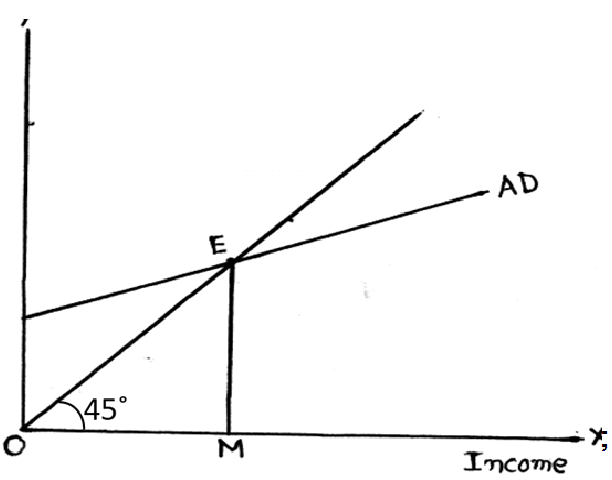
Explain national income equilibrium through aggregate demand and aggregate supply. Use diagram. Also explain the changes that take place in an economy when the economy is not in equilibrium.
Generate a complete, print-ready paper with questions like this in minutes — across 16+ boards, with answer keys.
|
|
|
(₹ crore)
|
|
(i)
|
Transfer payments by government
|
7
|
|
(ii)
|
Government final consumption expenditure
|
50
|
|
(iii)
|
Net imports
|
(-)10
|
|
(iv)
|
Net domestic fixed capital formation
|
60
|
|
(v)
|
Private final consumption expenditure
|
300
|
|
(vi)
|
Private income
|
280
|
|
(vii)
|
Net factor income to abroad
|
(-)5
|
|
(viii)
|
Closing stock
|
8
|
|
(ix)
|
Opening stock
|
8
|
|
(x)
|
Depreciation
|
12
|
|
(xi)
|
Corporate tax
|
60
|
|
(xii)
|
Retained earnings of corporations
|
20
|
| S.No. | Particulars | Amount (In ₹ crores) |
| (i) | National Income | 71,000 |
| (ii) | Gross Domestic Capital Formation | 10,000 |
| (iii) | Government Final Consumption Expenditure | ? |
| (iv) | Mixed Income of Self Employed | ? |
| (v) | Net Factor Income from Abroad | 1,000 |
| (vi) | Net Indirect Taxes | 2,000 |
| (vii) | Profits | 1,200 |
| (viii) | Wages & Salaries | 15,000 |
| (ix) | Net Exports | 5,000 |
| (x) | Private Final Consumption Expenditure | 40,000 |
| (xi) | Consumption of Fixed Capital | 3,000 |
| (xii) | Operating Surplus | 30,000 |