Question
Explain network, junction point (branch point) and loop.

Answer

Simple circuits can be easily understood by using ohm's law only.
"If the components of circuit like resistors, capacitors, inductors and electric cells are connected to each other in a very complex way, then such a circuit cannot be studied just by using ohm's law. Such a complex circuit is called a network."
Junction point (branch point) : The point in a network, where more than two conductors meet is called a junction point (or branch point)
Loop : A closed circuit formed by conductors is called loop.
Need a full question paper?

Generate a complete, print-ready paper with questions like this in minutes — across 16+ boards, with answer keys.

Start Generating Free

Similar questions

A transparent paper (refractive index = 1.45) of thickness 0.02mm is pasted on one of the slits of a Young's double slit experiment which uses monochromatic light of wavelength 620nm. How many fringes will cross through the centre if the paper is removed?
Deduce the expression for the magnetic dipole moment of an electron orbiting around the central nucleus.
The susceptibility of annealed iron at saturation is 5500. Find the permeability of annealed iron at saturation.
Answer the following questions regarding earth’s magnetism:
A vector needs three quantities for its specification. Name the three independent quantities conventionally used to specify the earth’s magnetic field.
In a standing wave pattern in a vibrating air column, nodes are formed at a distance of 4.0cm. If the speed of sound in air is 328m/s, what is the frequency of 73 the source?
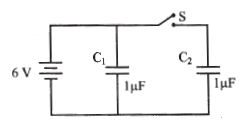
Figure shows two identical capacitors, C1 and C2, each of 1 μF capacitance connected to a battery of 6 V. Initially switch 'S' is closed. After sometime 'S' is left open and dielectric slabs of dielectric constant K = 3 are inserted to fill completely the space between the plates of the two capacitors. How will the (i) charge and (ii) potential difference between the plates of the capacitors be affected after the slabs are inserted?

A lamp attached to a cycle glows by a dynamo. When cycle is moved at greater speed, the lamp glows brightly and when cycle moves with a lesser speed, it glows dimly. Why?
State factors on which the resistance of a conductor depends.
A concave mirror and a converging lens have the same focal length in air. Which one of the two will have greater focal length when both are immersed in water?
If Bohr’s quantisation postulate (angular momentum $=\text{nh}/\pi$) is a basic law of nature, it should be equally valid for the case of planetary motion also. Why then do we never speak of quantisation of orbits of planets around the sun?