Question
Explain nitration of phenol in detail.

Answer

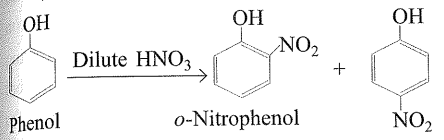
→ Nitration: With dilute nitric acid at low temperature (298 K), phenol yields a mixture of ortho and para nitrophenols.
Image
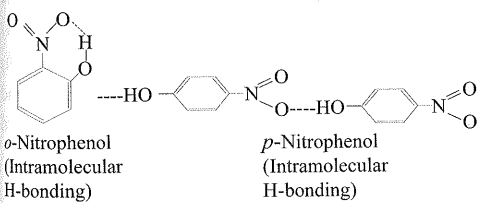
→ The ortho and para isomers can be separated by steam distillation. o-Nitrophenol is steam volatile due to intramolecular hydrogen bonding while p-nitrophenol is less volatile due to intermolecular hydrogen bonding which causes the association of molecules.
Image
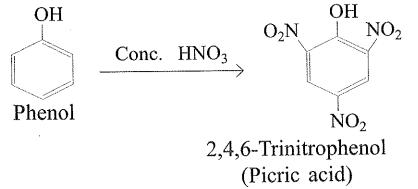
→ With concentrated nitric acid, phenol is converted to 2,4,6-trinitrophenol. The product is commonly known as picric acid. The yield of the reaction product is poor.
Image
→ Nowadays picric acid is prepared by treating phenol first with concentrated sulphuric acid which converts into phenol-2,4-disulphonic acid, and then with concentrated nitric acid to get 2,4,6-trinitrophenol.

Need a full question paper?

Generate a complete, print-ready paper with questions like this in minutes — across 16+ boards, with answer keys.

Start Generating Free

Similar questions

What happens when?
(i) Acetaldehyde is heated with bleaching powder.
(ii) Ethyl bromide is heated with KCN.
(iii) Ethyl alcohol is oxidised.
What are main sources of Iodine? How it is extracted from sea weeds?
What is half-life of a reaction? Derive formula for half-life of zero and first order reaction.
Do the following conversions in not more than two steps:
  1. Benzoic acid to benzaldehyde.
  2. Ethylbenzene to Benzoic acid.
  3. Propanone to Propene.
Following compounds are given to you:
2-Bromopentane, 2-Bromo-2-methylbutane, 1-Bromopentane
  1. Write the compound which is most reactive towards SN2 reaction.
  2. Write the compound which is optically active.
  3. Write the compound which is most reactive towards $\beta$-elimination reaction.
While separating a mixture of ortho and para nitrophenols by steam distillation, name the isomer which will be steam volatile. Give reason.
Explain Equilibrium constant for Daniell by nernst equation and calculate it's value
Name the reagents used in the following reactions:
i. Oxidation of a primary alcohol to carboxylic acid.
ii. Oxidation of a primary alcohol to aldehyde.
iii. Bromination of phenol to 2,4,6-tribromophenol.
iv. Benzyl alcohol to benzoic acid.
v. Dehydration of propan-2-ol to propene.
vi. Butan-2-one to butan-2-ol.
Account for the following:
  1. CuCl2 is more stable than Cu2Cl2.
  2. Atomic radii of 4d and 5d series elements are nearly same.
  3. Hydrochloric acid is not used in permanganate titrations.
How the following conversions can be carried out?
i. 2-Bromopropane to 1-bromopropane
ii. Chloroethane to butane
iii. Benzene to diphenyl