Question
Explain Oersted's experiment. What conclusions were drawn from it? What do you understand by magnetic field? How direction and intensity of magnetic field determined?

Answer

SELF

Need a full question paper?

Generate a complete, print-ready paper with questions like this in minutes — across 16+ boards, with answer keys.
Start Generating Free

Similar questions

How are fundamental logic gates OR, AND and NOT obtained from NOR gates ?
A spherical tungsten piece of radius $1.0\ cm$ is suspended in an evacuated chamber maintained at $300K.$ The piece is maintained at $1000K$ by heating it electrically. Find the rate at which the electrical energy must be supplied. The emissivity of tungsten is $0.30$ and the Stefan constant $\sigma$ is $6.0 \times 10^{-8}Wm^{-2}K^{-4}.$
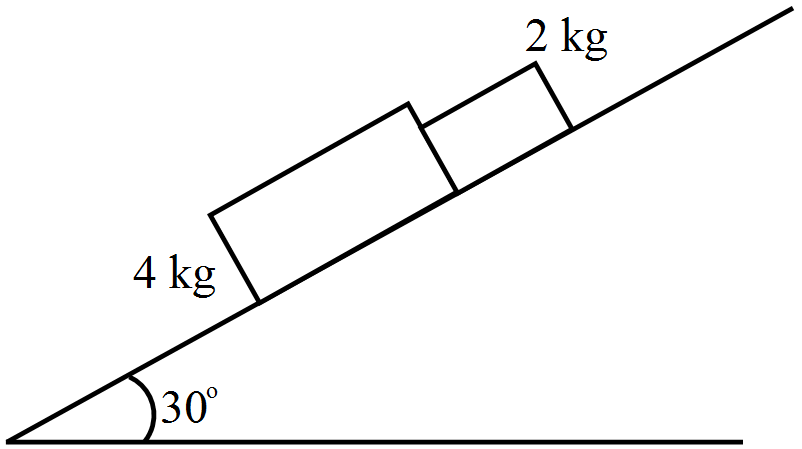
Figure shows two blocks in contact sliding down an inclined surface of inclination $30^\circ .$ The friction coefficient between the block of mass $2.0\ kg$ and the incline is $\mu_1,$ and that between the block of mass $4.0\ kg$ and the incline is $\mu_2.$ Calculate the acceleration of the $2.0\ kg$ block if:
  1. $\mu_1=0.20$ and $\mu_2=0.30$
  2. $\mu_1=0.30$ and $\mu_2=0.20$ Take $\text{g}=10\text{m/s}^2.$
A light beam of wavelength $400$ run is incident on a metal plate of work function $2.2\ eV.$
  1. A particular electron absorbs a photon and makes two collisions before coming out of the metal. Assuming that $10\%$ of the extra energy is lost to the metal in each collision, find the kinetic energy of this electron as it comes out of the metal.
  2. Under the same assumptions, find the maximum number of collisions the electron can suffer before it becomes unable to come out of the metal.
​​​​​​​
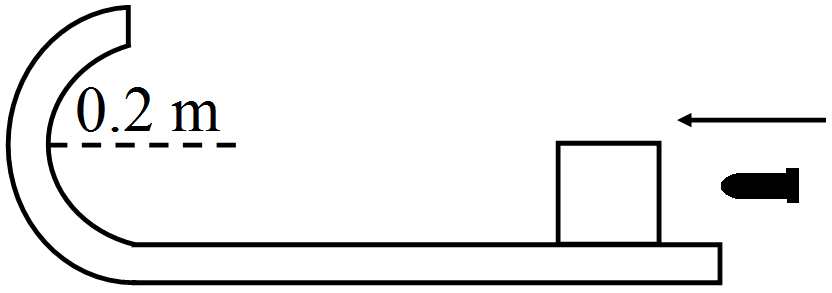
A bullet of mass $10g$ moving horizontally at a speed of $5017m/s$ strikes a block of mass $490g$ kept on a frictionless track as shown in figure. The bullet remains inside the block and the system proceeds towards the semicircular track of radius $0.2m$. Where will the block strike the horizontal part after leaving the semicircular track ?
An electric bulb is designed to consume 55W when operated at 110 volts. It is connected to a 220V, 50Hz line through a choke coil in series. What should be the inductance of the coil for which the bulb gets correct voltage?
A rod, when suspended in a magnetic field, stays in the east-west direction. Can we be sure that the field is in the east-west direction? Can it be in the north-south direction?
Consider an excited hydrogen atom in state $n$ moving with a velocity $u(ν << c).$ It emits a photon in the direction of its motion and changes its state to a lower state $m.$ Apply momentum and energy conservation principles to calculate the frequency $ν$ of the emitted radiation. Compare this with the frequency $ν_0$ emitted if the atom were at rest.
A long solenoid with $15 $ turns per $\ cm$ has a small loop of area $2.0 \ cm^2$ placed inside the solenoid normal to its axis. If the current carried by the solenoid changes steadily from $2.0A$ to $4.0A$ in $0.1s,$ what is the induced emf in the loop while the current is changing?
A coil of resistance $40\Omega$ is connected across a 4.0V battery 0.10s after the battery is connected, the current in the coil is 63mA. Find the inductance of the coil.