Question
Explain Ohm's law.

Answer

→Statement of Ohm's law :
"Under a definite physical condition, the current (I) flowing through the conductor is directly proportional to the potential difference (V) applied across its ends."
This law was discovered by G.S. Ohm.
Imagine a conductor in which a current I is flowing and the potential difference between the ends of the conductor is V .
According to Ohm's law
$\begin{aligned}
V & \propto I \\
\therefore \quad V & = RI
\end{aligned}$
Where R is the constant of proportionality. It is called the resistance of the conductor.
The SI unit of resistance is ohm and it is denoted by $\Omega$.
The resistance depends on the
(i) material
(ii) temperature and
(iii) dimensions of the conductor.

Need a full question paper?

Generate a complete, print-ready paper with questions like this in minutes — across 16+ boards, with answer keys.
Start Generating Free

Similar questions

Mention the disadvantages of phasor method of analysing AC circuits.
Answer the following questions:
A choke coil in series with a lamp is connected to a dc line. The lamp is seen to shine brightly. Insertion of an iron core in the choke causes no change in the lamp’s brightness. Predict the corresponding observations if the connection is to an ac line.
No interference pattern is detected when two coherent sources are infinitely close to each other. Why?
The quantities of charge on the two conducting spheres of radius 4 cm and 7 cm are 500 micro coulombs and 60 micro coulombs respectively. Calculate the loss in electrical potential energy when conductors are joined together.
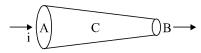
In the given figure, a current carrying conductor of non-uniform cross-section is shown. At what points, the magnitude will be maximum of (i) current (ii) current density and (iii) drift velocity?
Image
In a Young's double slit experiment, two narrow vertical slits placed 0.800mm apart are illuminated by the same source of yellow light of wavelength 589nm. How far are the adjacent bright bands in the interference pattern observed on a screen 2.00m away?
Write the formula to find the Rydberg's constant and what is the value of their constant?
Can you add three unit vectors to get a unit vector? Does your answer change if two unit vectors are along the coordinate axes?
A particle moves on a given straight line with a constant speed v. At a certain time it is at a point P on its straight line path. O is a fixed point. Show that $\overrightarrow{\text{OP}}\times\overrightarrow{\text{v}}$ is independent of the position P.
A power transmission line feeds input power at 2300V to a stepdown transformer with its primary windings having 4000 turns. What should be the number of turns in the secondary in order to get output power at 230 V?