Question
Explain optical isomerism in co$-$ordination compound.

Answer

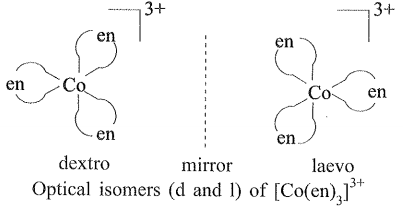
$\rightarrow$ Optical isomers are mirror images that cannot be superimposed on one another.
$\rightarrow$ These are called as enantiomers.
$\rightarrow$ The molecules or ions that cannot be superimposed are called chiral.
$\rightarrow$ The two forms are called dextro $(d)$ and laevo $(1)$ depending upon the direction they rotate the plane of polarised light in a polarimeter
$\rightarrow$ Dextro $(d)$ rotates plane polarised light to the right, and leaevo $(1)$ rotates plane polarised light to the left.
Image
$\rightarrow$ Optical isomerism is common in octahedral complexes involving didentate ligands
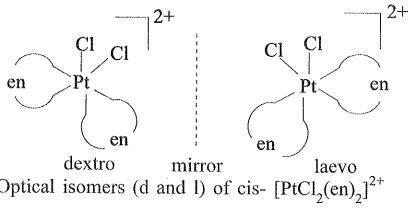
$\rightarrow$ In a coordination entity of the type $[PtCl_2(en)_2]^{2+},$ only the cis isomer shows optical activity.
Image

Need a full question paper?

Generate a complete, print-ready paper with questions like this in minutes — across 16+ boards, with answer keys.
Start Generating Free

Similar questions

Write the IUPAC name of $Fe_4 [Fe(CN)_6]_3$.
Calculate the charge of one mole of electrons.
i. Define crystal field splitting energy. On the basis of crystal field theory, write the electronic configuration for $d^4$ ion if $\triangle_0<P$.
ii. $\left[\mathrm{Ni}(\mathrm{CN})_4\right]^{2-}$ is colourless whereas $\left[\mathrm{Ni}\left(\mathrm{H}_2 \mathrm{O}\right)_6\right]^{2+}$ is green. Why? (At. no. of $\mathrm{Ni}=28$ )
  1. For the complex $[Fe(H_2O)_6]^{3+},$ write the hybridization, magnetic character and spin of the complex. $($At. number: $Fe = 26)$
  2. Draw one of the geometrical isomers of the complex $[Pt(en)_2Cl_2]^{2+}$ which is optically inactive.
An element $‘X’ ($At. mass $= 40g\ mol^{-1})$ having f.c.c. structure, has unit cell edge length of $400$pm. Calculate the density of $‘X’$ and the number of unit cells in $4$g of $‘X’ (N_A = 6.022 \times 10^{23}\ mol^{-1}).$
Predict, giving reasons, the order of basicity of the following compounds in (i) gaseous phase and (ii) in aqueous solutions $(CH_3)_3N, (CH_3)_2NH, CH_3NH_2, NH_3.$
In the button cell widely used in watches and other devices the following reaction takes place:
$Zn(s)+Ag_2 O(s)+H_2 O(l) \rightarrow Zn^{2+}(a q)+2 Ag(s)+2 OH^{-}(a q)$
Determine $\Delta_r G^{(-)}$and $E ^{(-)}$for the reaction
Given $Z n \rightarrow Z n^{2+}+2 e^{-}, E ^0=0.76 V$
Given $Ag \rightarrow Ag ^{+}+2 e^{-}, E ^0=0.344 V$
  1. Indicate the principle behind the method used for the refining of zinc.
  2. What is the role of silica in the extraction of copper?
  3. Which form of the iron is the purest form of commercial iron?
A first order reaction has a rate constant of $0.0051\ min^{–1}$. If we begin with $0.10 M$ concentration of the reactant, what concentration of the reactant will be left after $3$ hours?
Although thermodynamically feasible, in practice, magnesium metal is not used for the reduction of alumina in the metallurgy of aluminium. Why?