Question
Explain optical isomerism in co$-$ordination compound.

Answer

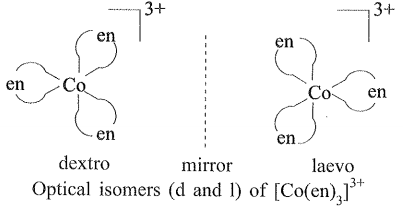
$\rightarrow$ Optical isomers are mirror images that cannot be superimposed on one another.
$\rightarrow$ These are called as enantiomers.
$\rightarrow$ The molecules or ions that cannot be superimposed are called chiral.
$\rightarrow$ The two forms are called dextro $(d) $ and laevo $(1)$ depending upon the direction they rotate the plane of polarised light in a polarimeter
$\rightarrow$ Dextro $(d)$ rotates plane polarised light to the right, and leaevo $(1)$ rotates plane polarised light to the left.
Image
$\rightarrow$ Optical isomerism is common in octahedral complexes involving didentate ligands
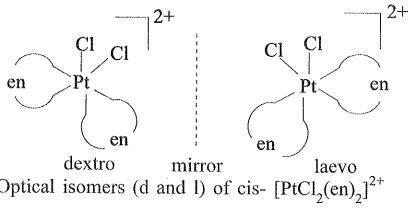
$\rightarrow$ In a coordination entity of the type $\ce{[PtCl_2(en)_2]^{2+}},$ only the $cis$ isomer shows optical activity.​​​​​​​
Image

Need a full question paper?

Generate a complete, print-ready paper with questions like this in minutes — across 16+ boards, with answer keys.
Start Generating Free

Similar questions

a. Give the structure of all the possible dipeptides formed when the following two amino acids form a peptide bond.
Image
b. Keratin, insulin, and myosin are a few examples of proteins present in the human body. Identify which type of protein is keratin and insulin and differentiate between them based on their physical properties.
Write down the number of 3d electrons in each of the following ions :
$Ti ^{2+}, V ^{2+}, Cr ^{3+}, Mn ^{2+}, Fe ^{2+}, Fe ^{3+}, Co ^{2+}, Ni ^{2+}, Cu ^{2+}$.
Indicate how would you expect the five 3d orbitals to be occupied for these hydrated ions (octahedral).
Explain dehydration of alcohols with chemical equations. And also give the order for relative ease of dehydration of alcohols.
Account for the following observations:
  1. $pK_b$ for aniline is more than that for methylamine.
  2. Methylamine solution in water reacts with ferric chloride solution to give a precipitate of ferric hydroxide.
  3. Aniline does not undergo Friedel$-$Crafts reaction.
How do you convert:
  1. Chlorobenzene to biphenyl.
  2. Propene to I-iodopropane.
  3. 2-bromobutane to but-2-ene.
A $5\%$ solution $($by mass$)$ of cane sugar in water has freezing point of $271K.$ Calculate the freezing point of $5\%$ glucose in water if freezing point of pure water is $273.15\ K.$
Write the mechanism of acid dehydration of ethanol to yield ethane.
The decomposition of $A$ into product has value of $k$ as $4.5 \times 10^3 s^{–1}$ at $10^\circ C$ and energy of activation $60\ kJ\  mol^{–1}$. At what temperature would $k$ be $1.5 \times 10^4s^{–1}$?
Write equations of the following reactions:
  1. Acetylation of aniline
  2. Coupling reaction
  3. Carbyl amine reaction