Question
Explain oxidation of aldehydes and ketones.
Answer

→ Aldehydes differ from ketones in their oxidation reactions. Aldehydes are easily oxidised to carboxylic acids on treatment with common oxidising agents like nitric acid, potassium permanganate, potassium dichromate, etc. Even mild oxidising agents, mainly Tollens' reagent and Fehlings' reagent also oxidise aldehydes.
$R - CHO \xrightarrow{[ O ]} R - COOH$
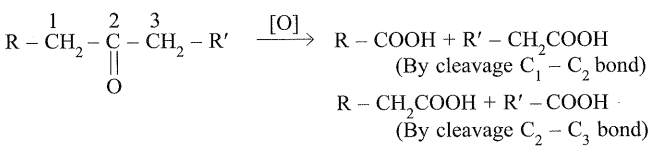
→ Ketones are generally oxidised under vigorous conditions, i.e., strong oxidising agents and at elevated temperatures. Their oxidation involves carbon-carbon bond cleavage to afford a mixture of carboxylic acids having lesser number of carbon atoms than the parent ketone.
Image

Need a full question paper?

Generate a complete, print-ready paper with questions like this in minutes — across 16+ boards, with answer keys.
Start Generating Free

Similar questions

Describe the basic strength of aryl amine compounds relative to ammonia.
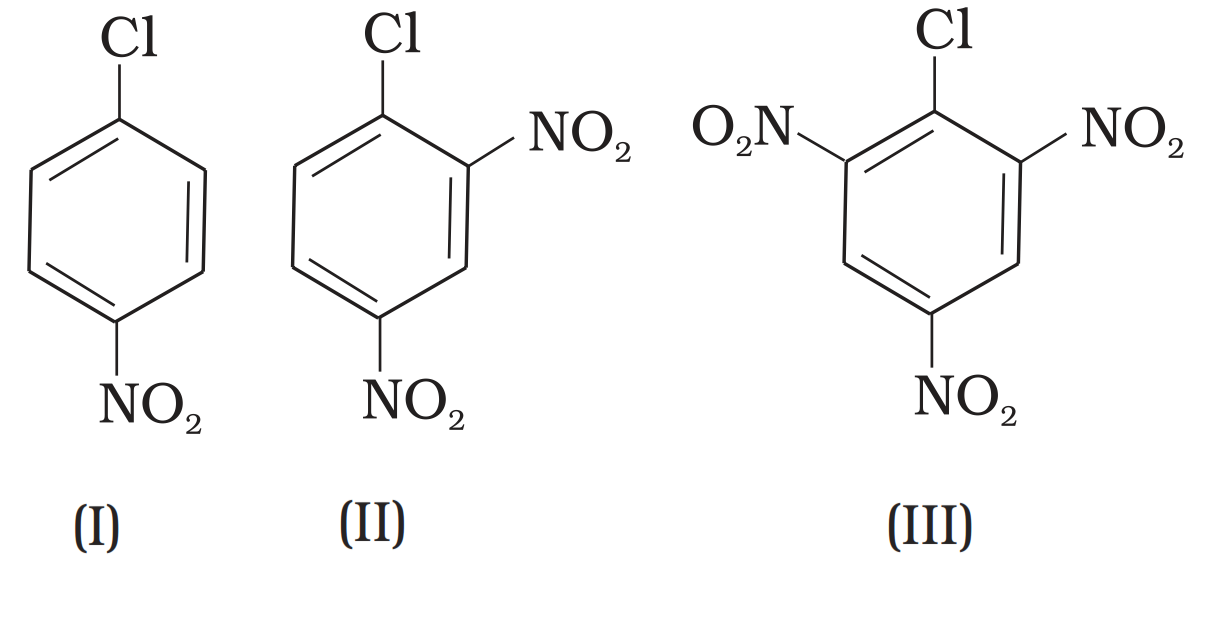
Aryl halides are extremely less reactive towards nucleophilic substitution. Predict and explain the order of reactivity of the following compounds towards nucleophilic substitution:

The mixture of ethyl alcohol and cyclohexane shows positive deviation from Raoult's law. Why?
Identify A and B in each of the following processes:
  1. $\text{CH}_{3}\text{CH}_{2}\text{Cl}\xrightarrow{\text{NaCN}}\text{A}\xrightarrow[\text{Ni/H}_{2}]{\text{reduction}}\text{B}$.
  2. $\text{C}_{6}\text{H}_{5}\text{NH}_{2}\xrightarrow{\text{NaNO}_{2}/\text{HCl}}\text{A}\xrightarrow[\text{OH}^{-}]{\text{C}_{6}\text{H}_{5}\text{NH}_{2}}\text{B}$.
Of all the methods of preparing amines identify by which aniline cannot be prepared?
Using IUPAC norms write the formulae for the following :
  1. Potassium trioxalatoaluminate(III)
  2. Dichloridobis(ethane-1,2-diamine)cobalt(III)
Although phenoxide ion has more number of resonating structures than carboxylate ion, carboxylic acid is a stronger acid than phenol. Why?
What are polyhalogen compounds? Write note on dichloromethane (Methylene Chloride)
The following data were obtained during the first order thermal decomposition of SO2Cl2 at a constant volume:
SO2Cl2(g) $\rightarrow$SO2(g) + Cl2(g)
Experiment
Time/s–1
Total pressure/atm
1
0
0.4
2
100
0.7
Calculate the rate constant.
(Given: log4 = 0.6021, log2 = 0.3010).
Using the standard electrode potentials given in Table 3.1, predict if the reaction between the following is feasible:
Fe3+(aq) and I (aq)