Question
Explain ‘Paradox of Thrift’.
Answer

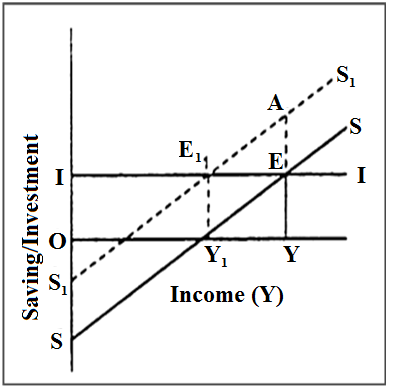
Paradox of thrift: Since start of human civilisation it was considered a virtue to keep consumption level at the minimum but the lasting effects and chain reactions of keeping consumption in check were not realised. People were taught that thrift or savings are good because a penny saved today will bring increased income. In this connection, Keynes pointed out paradox of thrift and showed that as people become more thrifty, they end up saving less or same as before. If all the people of an economy increased the proportion of income which is saved (i.e., MPS), the value of savings in the economy will not increase, rather it will decline or remain unchanged. Let us understand this statement with the help of the figure.
In Fig, initial saving curve is SS and investment curve is II. Economy attains equilibrium (saving = investment) at E and equilibrium level of income is OY. Now, suppose the society decides to become thrifty and increases saving by, say, AE. As a result saving curve shifts upward to $S_1 S_1$ intersecting investment curve II at $E_1$ Unplanned inventories will increase and firms will cut down production and employment and move to new equilibrium $E _1$ The Figure shows that in the end, planned saving has fallen from $A Y$ to $E _1 Y _1$. Notice at new point of equilibrium $E _{1,}$, the investment level and also realised saving remain the same $\left(E_1 Y_1\right)$ but level of income has fallen from $O Y$ to $O Y_1$. The decline in equilibrium level of income shows the paradox of thrift as the reverse process of multiplier has worked on reducing consumption expenditure. In fact, increased saving is virtually a withdrawal from circular flow of income.

Need a full question paper?

Generate a complete, print-ready paper with questions like this in minutes — across 16+ boards, with answer keys.

Start Generating Free

Similar questions

Are the following a part of a country's 'net domestic product at market price'? Explain:
  1. Net indirect taxes.
  2. Net exports.
  3. Net factor income from abroad.
  4. Consumption of fixed capital.
Explain the equilibrium level of income with the help of saving and investment curves. If savings exceed planned investment, what changes will bring about the equality between them?
OR
Explain with the help of a diagram and using Saving = Investment approach the determination of equilibrium output and income level in an economy. What happens when the economy is not in equilibrium and saving exceeds investment?
What is 'deficient demand'? Explain the role of 'Bank Rate' in removing it.
Explain the functions of Central Bank.
Explain the main steps involved in the expenditure method of estimating national income.
From the data given below about an economy, calculate (a) investment expenditure and (b) consumption expenditure.
  1. Equilibrium level of income
5000
  1. Autonomous consumption
500
  1. Marginal propensity to consume
0.4
Calculate the (a) Gross National Product at market price, and (b) Net National Disposable Income:
    (in crores)
(i) Compensation of employees $2,500$
(ii) Profit $700$
(iii) Mixed income of self-employed $7,500$
(iv) Government final consumption expenditure $3,000$
(v) Rent $400$
(vi) Interest $350$
(vii) Net factor income from abroad $50$
(viii) Net current transfers to abroad $100$
(ix) Net indirect taxes $150$
(x) Depreciation $70$
(xi) Net exports $40$
Find out (a) national income and (b) net national disposable income:
  (Rs. crore)
  1. Factor income from abroad
15
  1. Private final consumption expenditure
600
  1. Consumption of fixed capital
50
  1. Government final consumption expenditure
200
  1. Net current transfers to abroad
(-) 5
  1. Net domestic fixed capital formation
110
  1. Net factor income to abroad
10
  1. Net imports
(-) 20
  1. Net indirect tax
70
  1. Change in stocks
(-) 10
What is the difference between revenue expenditure and capital expenditure? Explain how taxes and government expenditure can be used to influence distribution of income in the society.
From the following data, calculate (a) Gross Domestic Product at Factor Cost and (b) Factor Income To Abroad:
  (Rs. in $000$ crore)
  1. Compensation of employees
$800$
  1. Profits
$200$
  1. Dividends
$50$
  1. Gross national product at market price
$1,400$
  1. Rent
$150$
  1. Interest
$100$
  1. Gross domestic capital formation
$300$
  1. Net fixed capital formation
$200$
  1. Change in stock
$50$
  1. Factor income from abroad
$60$
  1. Net indirect taxes
$120$