Question
Explain polygenic inheritance pattern with the help of a suitable example.

Answer

Human height or skin colour are examples of polygenic inheritance.
Height trait is controlled by at least three gene pairs.
Additive effect allele contributes to the phenotypic expression of the trait.
The dominant alleles more are, more pronounced is the phenotypic expression or more in other word.
The recessive alleles less pronounced is the phenotypic expression.

Need a full question paper?

Generate a complete, print-ready paper with questions like this in minutes — across 16+ boards, with answer keys.
Start Generating Free

Similar questions

Explain the process of transcription in prokaryotes.
Read the following and answer any four questions from (i) to (v) given below:
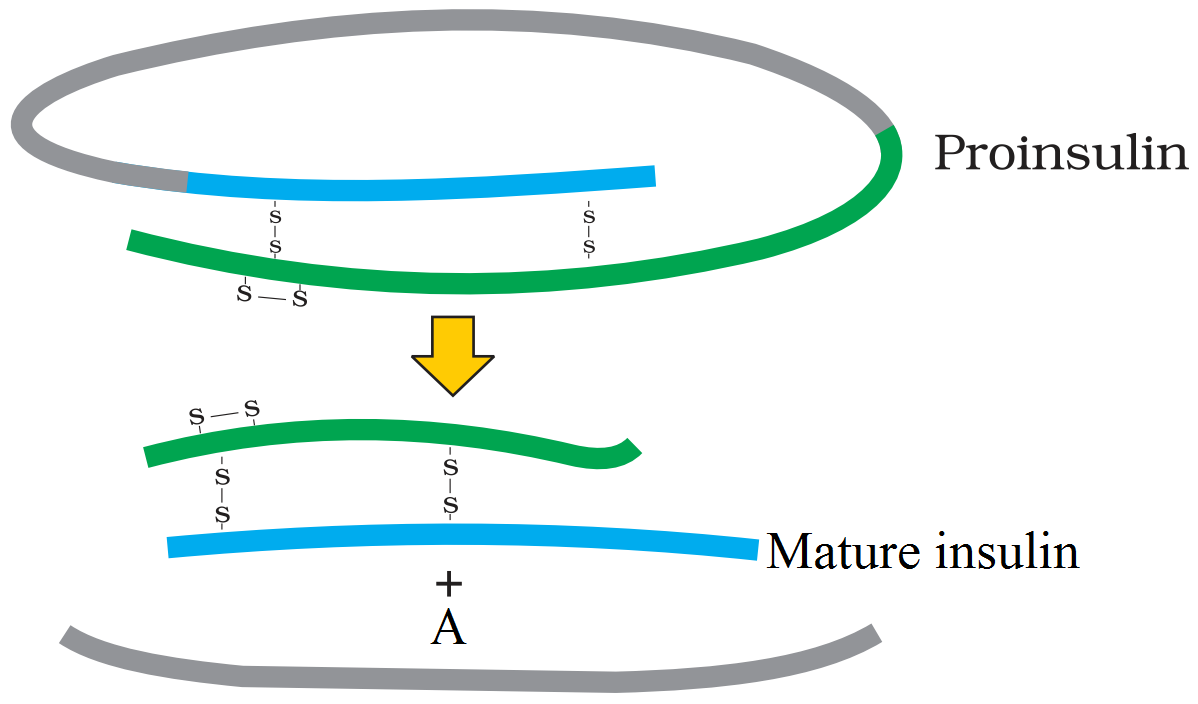
Insulin used to cure diabetes was earlier extracted from pancreas of slaughtered cattle and pigs. Insulin extracted from an animal source, though caused some patients to develop allergy or other types of reactions to the foreign protein. Human insulin consists of two short polypeptide chains : chain A and chain B, that are linked together by disulphide bridges. In mammals including humans, insulin is synthesised as a pro-hormone which contains an extra stretch called the C-peptide. This C peptide is not present in mature insulin and is removed during maturation into insulin.
  1. Identify A in the given figure.
  1. Polypeptide chain A.
  2. Polypeptide chain B.
  3. Polypeptide chain C.
  4. None of these.
  1. The following is a list of some stages involved in producing human insulin from genetically engineered bacteria.
  1. The bacteria are cultured in a fermenter for large scale production.
  2. Recombinant insulin is extracted from the bacterial cells that expresses insulin gene.
  3. The same restriction enzyme is used again to cut the bacterial plasmid for insertion of the human insulin gene.
  4. Bacteria take up the plasmid carrying the insulin gene.
  5. A restriction enzyme is used to cut human DNA to extract the insulin gene.
Select the correct order of these stages.
  1. 1, 5, 3, 4, 2
  2. 2, 4, 3, 5, 1
  3. 4, 5, 3, 2, 1
  4. 5, 3, 4, 1, 2
  1. To insert the insulin gene into bacterial DNA, both the bacterial plasmid and the human chromosome containing the insulin gene are treated with the same restriction enzyme. Using the same restriction enzyme ensures that
  1. DNA ligase is able to join the segments of human and bacterial DNA.
  2. The exact length of nucleotides matching the insulin gene is removed from the plasmid.
  3. Both the bacterial and human DNA will contain sticky ends.
  4. Sticky ends in the cut plasmid and insulin gene are complementary.
  1. Why is the fermentor important for the production of human insulin by transgenic bacteria?
  1. It provides optimal conditions for the transgenic to multiply rapidly.
  2. It facilitates the extraction and purification of insulin from the transgenic bacteria.
  3. It maximise the rate of fermentation of the transgenic bacteria.
  4. It provides the low-oxygen conditions that are important for insulin production.
  1. A bacteriologist carries out his first attempt at engineering E.coli with the gene for human insulin. During the process, he realises that his stock of DNA ligase has depleted but decides to continue anyway. What is a likely consequence of his decision?
  1. Bacteria with the rDNA will not be able to form colonies in a fermenter.
  2. The resulting plasmids are not able to enter the E.coli bacteria even after applying heat shock.
  3. The resulting E.coli bacteria do not contain the human insulin gene.
  4. The bacterial plasmids do not have sticky ends and are unable to accommodate the human gene.
Describe the ill-effects of alcohol on different parts of a body of an individual.
"Analysis of age-pyramids for human population can provide important inputs for long-term planning strategies." Explain.
Arun visited his grandfather's farm and noticed that one of the workers was introducing earthworms in the soil. He quickly rushed to his grandfather and asked him the reason. His grandfather explained him the advantages of earthworm in soil improvement.
  1. Why are earthworms also known as detritivores?
  2. Explain fragmentation.
  3. Name the steps in the process of decomposition.
  4. What values are shown by Arun?
Answer the following questions:
Explain Polygenic inheritance and Multiple allelism with the help of suitable examples.
Write the scientific name of the bacteria that causes pneumonia. What happens in this disease? What are its symptoms?
Describe in detail about food chain and food web existing in an ecosystem.
Define acquired immunity and describe its types.
Why is thalassemia categorised as a Mendelian disorder? State the condition when an individual will suffer from the disease.