Question
Explain population attributes.

Answer

→ A population has certain attributes whereas, an individual organism does not.
→ An individual may have births and deaths, but a population has birth rates and death rates.
→ In a population these rates refer to per capita births and deaths. The rates, hence, expressed are change in numbers (increase or decrease) with respect to members of the population
Birth rates : Refer to per capita births. E.g. In a pond, there are 20 lotus plants last year Through reproduction 8 new plants are added. Hence, the current population 28 The birth rate 8/20-0.4 offspring per lotus per year.
Death rates : Refer to per capita deaths.
E.g. 4 individuals in a laboratory population of 40 fruit flies died during a week. Hence, the death rate-4/40-0.1 individuals per fruit fly per week.
→ Sex ratio : A population has a sex ratio.
E.g. 60% of the population is females and 40% males
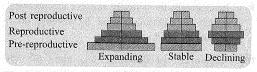
→ Age pyramid : It is the structure obtained when the age distribution (% individuals of a given age or age group) is plotted for the population.
→ For human population, age pyramids generally show age distribution of males and females in a combined diagram.
Image
Population size or population density (N) : It is the number of individuals of a species per unit area or volume.
→ E.g. population density of Siberian cranes at Bharatpur wetlands in any year is <10. It is millions for Chlamydomonas in a pond.
Growth status Expanding (growing) Representation of age pyramids for human population, population size is also measured in % cover or biomass.
→ E.g. In an area, 200 Parthenium plants and a huge banyan tree are seen. In such cases, measuring % cover or biomass is meaningful to show importance of banyan tree.
Total number is a difficult measure for a huge population. In such cases, relative population density (without knowing absolute population density) is used.
→ E.g. Number of fish caught per trap indicates its total population density in the lake.
→ In some cases, indirect estimation of population sizes is performed. E.g. Tiger census in national parks & tiger reserves based on pug marks & fecal pellets.

Need a full question paper?

Generate a complete, print-ready paper with questions like this in minutes — across 16+ boards, with answer keys.

Start Generating Free

Similar questions

Read the following text carefully and answer the questions that follow:
The pathogen of a disease depends on RBCs of human for growth and reproduction. The person with this
pathogen suffers with chill and high fever.
Image
i. Identify the disease. (1)
ii. Name the pathogen. (1)
iii. What is the cause of fever? (2)
OR
Represent the life cycle of the pathogen diagrammatically. (2)
Read the following and answer any four questions from (i) to (v) given below:
IUCN maintains a Red Data Book or Red List which is a catalogue of taxa facing risk of extinction. The IUCN Red List (2004) documents the extinction of 784 species in the last 500 years. Some examples of recent extinctions include the dodo, quagga, thylacine and Steller's sea cow. The last twenty years alone have witnessed the disappearance of 27 species. Red List has eight categories of species.
  1. Dodo, an extinct taxon, belongs to which country?
  1. Mauritius
  2. Africa
  3. Australia
  4. Russia
  1. To which of the following categories of IUCN, Berberis nilghiriensis belongs?
  1. Extinct.
  2. Extinct in wild.
  3. Endangered.
  4. Critically endangered.
  1. Steller's sea cow and passenger pigeon became extinct due to:
  1. Alien species invasion.
  2. Over-exploitation.
  3. Coextinctions.
  4. Intensive agriculture.
  1. Bali, Javan and Caspian are:
  1. Species of tiger.
  2. Species of cheetah.
  3. Subspecies of cheetah.
  4. Subspecies of tiger.
  1. Select the correct term for the following definitions (i, ii, iii, iv).
  • The taxon is liable to become extinct if not allowed to realise its full biotic potential by providing protection from exotic species/ human exploitation/habitat deterioration/depletion of food.
  • The taxon has been completely eliminated or died out from earth, e.g., Dodo.
  • The taxon is facing a high risk of extinction in the wild in the near future due to decrease in its habitat, excessive predation or poaching.
  • They are species with naturally small populations, either localised or thinly scattered, which are always at risk from pests/ pathogens/ predators/ exotic species.
 
(i)
(ii)
(iii)
(iv)
(a)
Threatened
Extinct
Endangered
Rare
(b)
Endangered
Extinct
Threatened
Rare
(c)
Extinct
Rare
Threatened
Endangered
(d)
Threatened
Extinct
Rare
Endangered
Read the following text carefully and answer the questions that follow:
The following is the illustration of the sequence of ovarian events (a-i) in a human female.
Image
i. Identify the figure that illustrates ovulation and mentions the stage of oogenesis it represents. (1)
ii. Name the ovarian hormone and the pituitary hormone that have caused the above-mentioned event. (1)
iii. Explain changes that occur in the uterus simultaneously in anticipation. (2)
OR
Draw a labelled sketch of the structure of a human ovum prior to fertilization. (2)
What is oogenesis? Give a brief account of oogenesis.###Define or Characterise: (i) Primary oocyte. (ii) Primary follicle. (iii) Secondary follicle. (iv) Tertiary follicle. (v) Antrum. (vi) Secondary oocyte. (vii) Graafian follicle.
Read the following and answer any four questions from (i) to (v) given below:

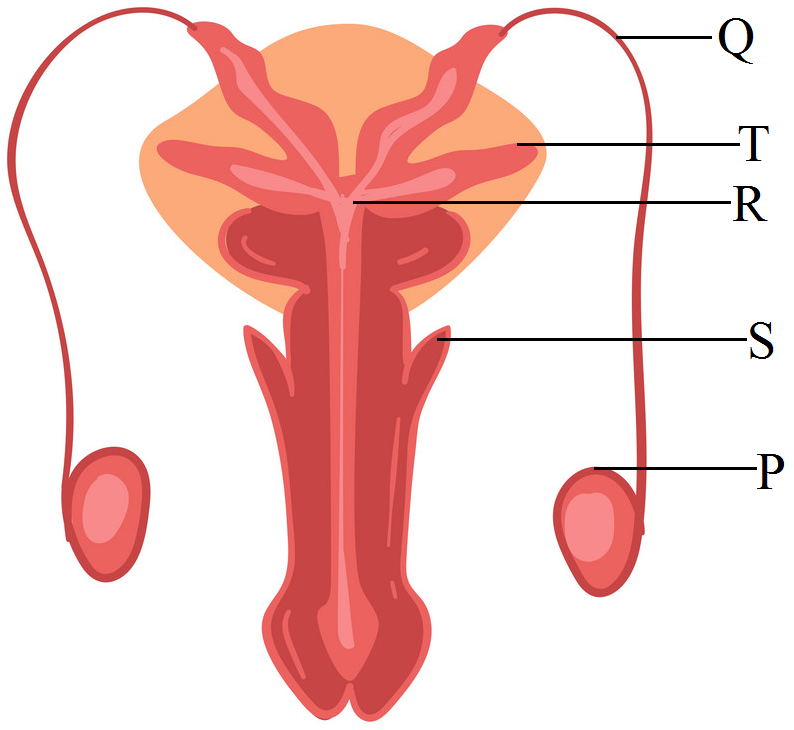
Human male reproductive system comprises of a pair of testes, primary sex organs associated with formation of gametes and production of sex hormone. Study the given figure of human male reproductive system and answer the following questions.

  1. Which of the following is correct for labelled part P?
  1. P is rete testis which transports sperms to outside.
  2. P is epididymis which secretes fluid that nourish the sperms.
  3. P is epididymis that carry sperms and secretion of seminal vesicles.
  4. P is rete testis, which lies along inner side of each testis and stores the sperms.
  1. Identify the correctly matched pair.
  1. Q - Vasa efferentia.
  2. R - Ejaculatory duct.
  3. S - Seminal vesicle.
  4. T - Cowper's gland.
  1. Which statement is incorrect for Q?
  1. It carries spermatozoa from epididymis to ejaculatory duct.
  2. Q are only 2 in number.
  3. It arises from rete testis.
  4. It constitutes male sex accessory duct.
  1. Which structure passes through the prostate gland and carries sperms and secretion of seminal vesicle?
  1. P.
  2. T.
  3. S.
  4. R.
  1. Assertion: Mucus present in secretion of bulbourethral gland decreases the number of sperms damaged during ejaculation.

Reason: Mucus lubricates the end of penis and lining of the urethra.

  1. Both assertion and reason are true, and reason is the correct explanation of assertion.
  2. Both assertion and reason are true, but reason is not the correct explanation of assertion.
  3. Assertion is true, but reason is false.
  4. Both assertion and reason are false.
Explain co-dominance in humans with the help of example.
Explain Species-Area relationships graph.
What is the mechanism by which the AIDS virus causes deficiency of immune system of the infected person?
Read the following text carefully and answer the questions that follow:
Cleavage is the series of rapid mitotic divisions in zygote and forms blastula. The 2, 4, 8, 16 daughter cells are called blastomeres. Embryo with 64 blastomeres is known as blastocyst and has blastocoel cavity. Blastocyst gets implanted in uterine wall and leads to pregnancy.
i. Why the cells of the inner cell mass of blastocyst are called stem cells? (1)
ii. At which stage of embryonic development trophoectoderm develops? (1)
iii. What is the site of implantation? (2)
OR
What is the correct sequence of various structures formed during embryonic development? (2)
Read the following and answer any four questions from (i) to (v) given below:

Riya studies in 11 standard in a government school. She belongs to a backward family and her parents did not get her properly vaccinated according to immunisation programme. Once while playing in school playground she fell down due to weakness and developed high fever, headache and stiffness in her neck. identify the illness she could be suffering from and answer the following questions.

  1. The microbe responsible for Riya's illness could be.
  1. Vibrio cholerae
  2. Enterovirus
  3. Plasmodium
  4. Mycobacteriurn.
  1. Which vaccine, if administered earlier, would have saved Riya from the illness she unfortunately contracted?
  1. Salk vaccine
  2. MMR vaccine
  3. BCG vaccine
  4. Varicella vaccine
  1. The disease that Riya has contracted spreads through.
  1. Bite of an infected mosquito
  2. Bite of an infected dog
  3. Faecal oral route
  4. Direct contact with the infected person.
  1. Riya can spread her illness to other children through.
  1. Her faeces
  2. Direct contact
  3. Coughing and sneezing in open
  4. Vectors.
  1. Assertion: Polio produces inflammation of the nervous system.

Reason : Stiffness of the neck, paralysis of particular skeletal muscle, is an important symptom of polio.

  1. Both assertion and reason are true, and reason is the correct explanation of assertion.
  2. Both assertion and reason are true, but reason is not the correct explanation of assertion.
  3. Assertion is true, but reason is false.
  4. Both assertion and reason are false.