Question
Explain principle, construction and working of optical fibre.

Answer

Principle : total internal reflection
Fabricated from : composite glass/quartz fibres. (diameter 10 to $100 \mu m$ )
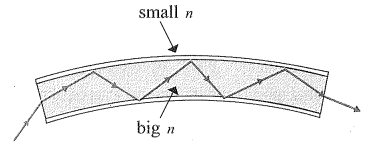
Image
Construction : Figure shows construction of optical fibre. Each fibre consists of certain core and certain cladding.
→The refractive index of the material of the core is higher than that of the cladding, which increases the probability of total internal reflection of the light ray.
Function : Optical fiber is designed in such a way that the light reflected at one side of inner surface striked the other at an angle larger than the critical angle. As a result, light repeatedly undergoes total internal reflection along the length of the fiber and eventually exits at the other end.
→Since light undergoes total internal reflection at each stage, there is no appreciable loss in the intensity of the light signal. Even if the fibre is bent, light can easily travel along its length.
$\bullet$ Uses :
→Electrical signals are converted into light with the help of transducers. Optical fibres are extensively used for tansmitting and receiving them.
→Optical fibres can also be used for transmission of optical signals.
→For example, these are used as light pipe to facilitate visual examination of internal organs like oesophagus, stomach and intestines.
→Decorative lamp in which the free ends of plastic fibres form a fountain like structure. Its one end is free and the other end is fixed over an electric lamp. When the lamp is switched on, the light travels from the bottom of each fibre and appears at the tip of its free end as a dot of light. The fibres in such decorative lamps are optical fibres.
The main requirement in fabricating optical fibre : Light travels for long distances inside them. However, it absorbs very little light. That is why optical fibres are made from materials like quartz.
→In silica glass fibres it is possible to transmit more than $95 \%$ of the light over a fibre length of 1 km .

Need a full question paper?

Generate a complete, print-ready paper with questions like this in minutes — across 16+ boards, with answer keys.
Start Generating Free

Similar questions

Define the term “cut off frequency” in photoelectric emission. The threshold frequency of a metal is f. When the light of frequency 2f is incident on the metal plate, the maximum velocity of photo-electrons is v1. When the frequency of the incident radiation is increased to 5f, the maximum velocity of photo-electrons is v2. Find the ratio v1 : v2.
An electron microscope uses electrons accelerated by a voltage of 50 kV. Determine the de-Broglie wavelength associated with the electrons. Taking other factors, such as numerical aperture etc. to be same, how does the resolving power of an electron microscope compare with that of an optical microscope which uses yellow light?
(II) (a) Define electric flux and write its SI unit.
(b) Use Gauss᾿s law to obtain the expression for the electric field due to a uniformly charged infinite plane sheet of charge.
A liquid-nitrogen container is made of a 1cm thick styrofoam sheet having thermal conductivity $0.025\text{Js}^{-1}\text{m}^{-1}{^\circ}\text{C}^{-1}.$ Liquid nitrogen at 80K is kept in it. A total area of 0.80m2 is in contact with the liquid nitrogen. The atmospheric temperature is 300K. Calculate the rate of heat flow from the atmosphere to the liquid nitrogen.
The energy flux of sunlight reaching the surface of the earth is $1.388 \times 10^3 W / m ^2$. How many photons (nearly) per square metre are incident on the Earth per second? Assume that the photons in the sunlight have an average wavelength of 550 nm .
A rod is inserted as the core in the current-carrying solenoid of the previous problem.
  1. What is the magnetic intensity H at the centre?
  2. If the magnetization I of the core is found to be 0.12Nm, find the susceptibility of the material of the rod.
  3. Is the material paramagnetic, diamagnetic or ferromagnetic?
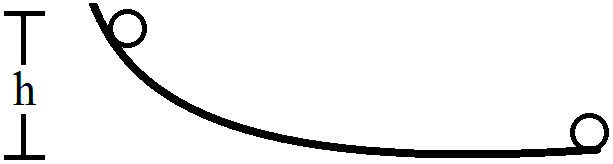
A small spherical ball is released from a point at a height h on a rough track shown in figure. Assuming that it does not slip anywhere, find its linear speed when it rolls on the horizontal part of the track.

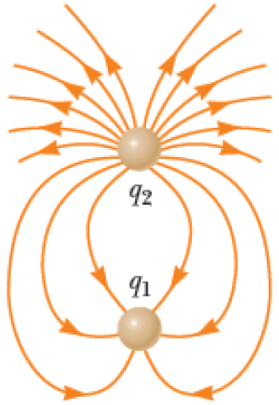
Consider the situation shown in figure. What are the signs of q1 and q2? If the lines are drawn in proportion to the charge, what is the ratio $\frac{\text{q}_1}{\text{q}_2}?$

The first excited energy of a He+ ion is the same as the ground state energy of hydrogen. Is it always true that one of the energies of any hydrogen-like ion will be the same as the ground state energy of a hydrogen atom?
Find the electric field intensity due to a uniformly charged spherical shell at a point (i) outside the shell and (ii) inside the shell. Plot the graph of electric field with distance from the centre of the shell.