Question
Explain quantitatively the order of magnitude difference between the diamagnetic susceptibility of N2 (~5 × 10-9) (at STP) and Cu (~10-5).

Answer

Key concept:
Magnetic susceptibility: It is the property of the substance which shows how easily a substance can be magnetised. It can also be defined as the ratio of intensity of magnetisation (I) in a substance to the magnetic intensity (H) applied to the substance, i.e., $\text{XM}=\frac{\text{I}}{\text{H}}$.
According to the problem, we have
Density of nitrogen $\rho_{\text{N}_2}=\frac{28\text{g}}{22.4\text{L}}=\frac{28\text{g}}{22400\text{cc}}$
Also, density of copper $\rho_{\text{Cu}}=\frac{8\text{g}}{22.4\text{L}}=\frac{8\text{g}}{22400\text{cc}}$
So, ration of both densities
$\frac{\rho_{\text{N}_2}}{\rho_\text{Cu}}=\frac{28}{22400}\times\frac{1}{8}=16\times10^{-4}$
Also given $\frac{\chi_{\text{N}_2}}{\chi_\text{Cu}}=\frac{5\times10^{-9}}{10^{-5}}=5\times10^{-4}$
we know that, $\chi=\frac{\text{Magentisation (M)}}{\text{Magnetic intensity (H)}}$
$=\frac{\text{Magnetic moment (M)/Volime (V)}}{\text{H}}$
$=\frac{\text{M}}{\text{HV}}=\frac{\text{M}}{\text{H}(\text{mass/density})}=\frac{\text{M}\rho}{\text{Hm}}$
$\chi\propto\rho\ \ \Big(\because\ \frac{\text{M}}{\text{Hm}}=\text{constant}\Big)$
Hence, $\frac{\chi_{\text{N}_2}}{\chi_\text{Cu}}=\frac{\rho_{\text{N}_2}}{\rho_\text{Cu}}=1.6\times10^{-4}$
Therefore, we can say that magnitude difference or major difference between the diamagnetic susceptibility of N2 and Cu is 1.6 × 10-4.

Need a full question paper?

Generate a complete, print-ready paper with questions like this in minutes — across 16+ boards, with answer keys.
Start Generating Free

Similar questions

Through what potential difference should an electron be accelerated to give it a speed of: 
  1. 0.6c
  2. 0.9c
  3. 0.99c
The earth revolves round the sun due to gravitational attraction. Suppose that the sun and the earth are point particles with their existing masses and that Bohr's quantization rule for angular momentum is valid in the case of gravitation. (a) Calculate the minimum radius the earth can have for its orbit. (b) What is the value of the principal quantum number n for the present radius? Mass of the earth = 6.0 × 10⁻²⁴kg. Mass of the sun = 2.0 × 1030kg, earth-sun distance = 1.5 × 10¹¹m.
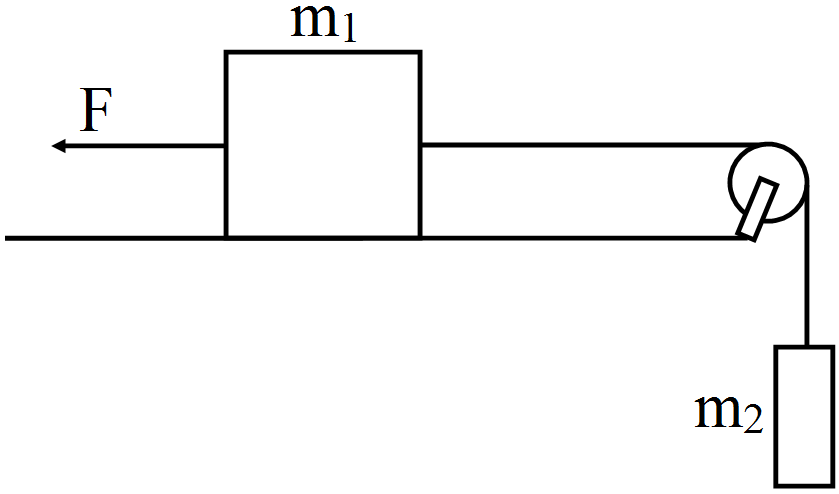
A constant force $\text{F}=\frac{\text{m}_2\text{g}}{2}$ is applied on the block of mass m1 as shown in figure. The string and the pulley are light and the surface of the table is smooth. Find the acceleration of m1.

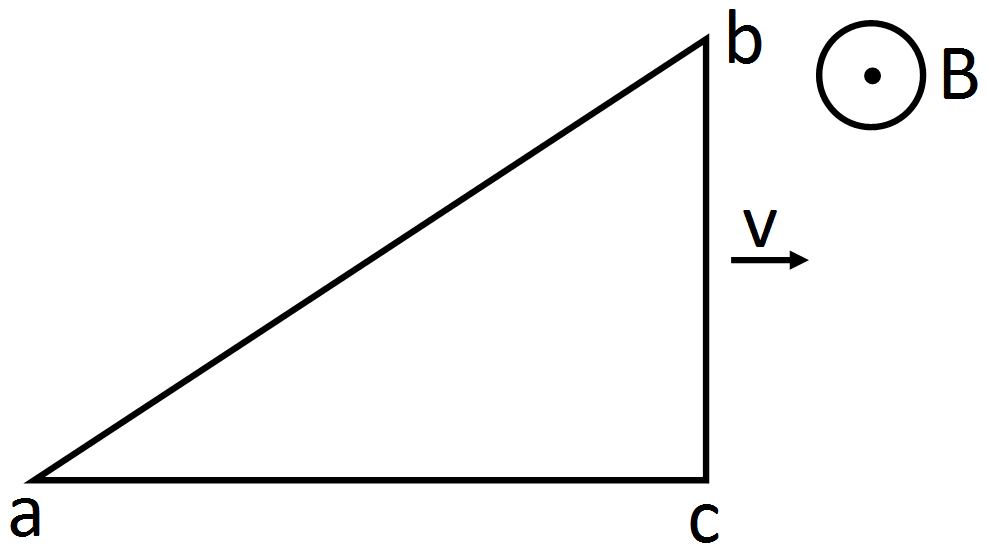
A right-angled triangle abc, made from a metallic wire, moves at a uniform speed v in its plane as shown in figure. A uniform magnetic field B exists in the perpendicular direction. Find the emf induced:
  1. In the loop abc.
  2. In the segment bc.
  3. In the segment ac.
  4. In the segment ab.

4.0g of helium occupies 22400cm3 at STP. The specific heat capacity of helium at constant pressure is 5.0cal-K-1mol-1. Calculate the speed of sound in helium at STP.
A radioactive isotope has a half-life of T years. How long will it take the activity to reduce to
  1. 3.125%,
  2. 1% of its original value?
Define electric flux. Find the expression for the electric field intensity due to the electric dipole at its axial point. Draw a diagram.
State Biot-Savart law, giving the mathematical expression for it.
Use this law to derive the expression for the magnetic field due to a circular coil carrying current at a point along its axis.
How does a circular loop carrying current behave as a magnet?
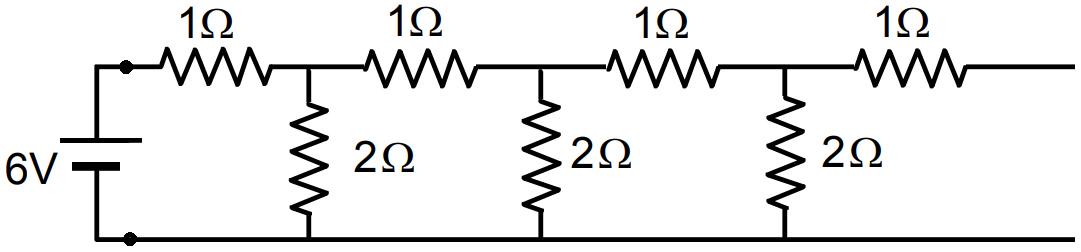
An infinite ladder is constructed with $1\Omega$ and $2\Omega$ resistors, as shown in the figure.

(a) Find the effective resistance between the points A and B. (b) Find the current that passes through the $2\Omega$ resistor nearest to the battery.

A normal eye has retina 2cm behind the eye-lens. What is the power of the eye-lens when the eye is
  1. Fully relaxed,
  2. Most strained?