Question
Explain Raoult's Law for volatile solute and Volatile solvent and derive formula for total vapour pressure with graph.

Answer

$\rightarrow$ Let us consider a binary solution of two volatile liquids and denote the two components as $1$ and $2 .$
$\rightarrow$ When taken in a closed vessel, both the components would evaporate and eventually an equilibrium would be established between vapour phase and the liquid phase.
$\rightarrow$ Suppose $p_1$ and $p_2$ partial vapour pressure of component $1$ and $2$ and $x_1$ and $x_2$ are MoleFraction of component $1$ and $2$ respectively.
$\rightarrow$ The French chemist, Francois Marte Raoult gave the quantitative relationship between them. The relationship is known as the Raoult's law
$\rightarrow$ "For a solution of volatile liquids the partial vapour pressure of each component of the solution is directly proportional to its mole fraction present in solution."
$\rightarrow$ For component $-1 .$
$p_1 \propto x_1$
$\therefore p_1=p_1^o \cdot x_1$
where $p_1^o$ is the vapour pressure of pure component $1$
$\rightarrow$ Similarly for component $-2$
$p_2 \propto x_2$
$\therefore p_2=p_2^\circ \cdot x_2$
where $p_2^o$ is the vapour pressure of pure component $2$
$\rightarrow$ According to Dalton's law of partial pressures,
$\rightarrow$ Total pressure over the solution phase in the container will be the sum of the partial pressures of the components of the solution
$ p_{\text {Total }} =p_1+p_2$
$= p_1^o \cdot x_1+p_2^o \cdot x_2$
$= p_1^o\left(1-x_2\right)+p_2^o \cdot x_2$
$= p_1^o-p_1^o \cdot x_2+p_2^o \cdot x_2$
$p_{\text {Total }} =p_1^o+x_2\left(p_2^o-p_1^o\right)$
$\rightarrow$ Following conclusions can be drawn from above equation
$(i)$ Total vapour pressure over the solution can be related to the mole fraction of any one component.
$(ii)$ Total vapour pressure over the solution varies linearly with the mole fraction of component $2.$
$(iii)$ Depending on the vapour pressures of the pure components $1$ and $2$, total vapour pressure over the solution decreases or increases with the increase of the mole fraction of component $1.$
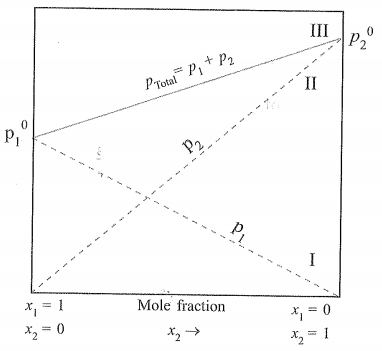
$\rightarrow$ A plot of $p_1$ or $p_2$ versus the mole fractions $x_1$ and $x_2$ for a solution gives a linear plot as shown in Fig.
Image
$\rightarrow$ These lines $(I$ and $II)$ pass through the points for which $x_1$ and $x_2$ are equal to unity.
$\rightarrow$ Similarly the plot $($line $III)$ of $p_{\text {total }}$ versus $x_2$ is also linear Fig.
$\rightarrow$ The minimum value of $p_{\text {Total }}$ is $p_1^o$ and the maximum value is $p_2^o$, assuming that component $-1$ is less volatile than component $-2\left(p_1^\circ < p_2^\circ\right)$
$\rightarrow$ The composition of vapour phase in equilibrium with the solution is determined by the partial pressures of the components.
$\rightarrow$ If $y_1$ and $y_2$ are the mole $-$ fraction of the component $1$ and $2$ respectively in vapour phase then,
$\rightarrow$ Using Dalton's Law of partial pressure
$p_1=y_1 \cdot p_{\text {Total }}$
$p_2=y_2 \cdot p_{\text {Total }}$
$\rightarrow$ In general
$p_i=y_i\ p _{\text {Total }}$

Need a full question paper?

Generate a complete, print-ready paper with questions like this in minutes — across 16+ boards, with answer keys.

Start Generating Free

Similar questions

Read the following text carefully and answer the questions that follow:
$KMnO _4$ and $K _2 Cr _2 O _7$ are most important chemicals which are used as oxidising agents and disinfectants. $K _2 MnO _4$ is prepared by fusing $MnO _2$ with KOH in presence of $O _2 \cdot K_2 MnO _4$ is electrolysed to get purple coloured $KMnO _4 \cdot Na _2 CrO _4$ is prepared by heating chromite ore with $Na _2 CO _3$ in presence of $O _2 \cdot Na _2 CrO _4$ is converted into $Na _2 Cr _2 O _7$ by reacting with concentrated $H _2 SO _4 \cdot Na _2 Cr _2 O _7$ is reacted with KCl to get $K _2 Cr _2 O _7$, orange coloured solid, soluble in water, changes to yellow coloured $CrO _4^{2-}$ in basic medium, $KMnO _4$ acts as oxidising agent in acidic, neutral as well basic medium. In acidic medium, it converts $Fe ^{2+}$ to $Fe ^{3+}, Sn ^{2+}$ to $Sn ^{4+}, COO ^{-}$to $CO ^2$. In basic medium it converts $I ^{-}$to $IO ^{3-} . K _2 Cr _2 O _7$ acts as oxidising agent only in acidic medium, converts $H _2 S$ to $S , SO _2$ to $SO ^{2-}, I ^{-}$to $I _2$. Lanthanoids and actinoids belong to f-block elements with general electronic configuration $(n-2) f^1$ to $14(n-1) d^{0-2} n s^2$. All actinoids are radioactive. Both show contraction in atomic and ionic radii but actinoid contraction is more than lanthanoid contraction. Lanthanoid show +3 oxidation state, few elements show +2 and +4 oxidation states also. Actinoids show $+3,+4,+5,+6,+7$ oxidation states.
i. Which lanthanoid shows +4 oxidation state and why?
ii. Give two similarities between lanthanoids and actinoids.
iii. Complete the equation and balance:
$
Cr_2 O_7^{2-}+Fe^{2+}+H^{+} \rightarrow ?
$
OR
iii. Convert sodium chromate to sodium dichromate. Give chemical equation.
$2 Na _2 CrO _4+ H _2 SO _4$ (conc.) $\rightarrow$ ?
Explain the effect of substituents on the acidity of carboxylic acids.
The d-block of the periodic table contains the elements of the groups 3 to 12 and are known as transition elements. In general, the electronic configuration of these elements is $(n-1) d^{1-10} n s^{1-2}$. The d-orbitals of the penultimate energy level in their atoms receive electrons giving rise to the three rows of the transition metals i.e. 3d, 4d and 5d series. However, $Zn , Cd$ and Hg are not regarded as transition elements. Transition elements exhibit certain characteristic properties like variable oxidation stables, complex formation, formation of coloured ions, alloys, catalytic activity etc. Transition metals are hard (except $Zn , Cd$ and Hg ) and have a high melting point.
i. Why are $Zn , Cd$ and Hg non-transition elements?
ii. Which transition metal of 3d series does not show variable oxidation state?
iii. Why do transition metals and their compounds show catalytic activity?
OR
iii. Why are melting points of transition metals high?
Write detailed note on the addition reaction of aldehydes and ketones with ammonia derivatives.
The mole fraction of helium in a saturated solution at $20^\circ C$ is $1.2 g 10-6.$ Find the pressure of helium above the solution. Given Henry's constant at $20^\circ C$ is $144.97\ k\ bar. (2)$
Read the following text carefully and answer the questions that follow:
The transition metals when exposed to oxygen at low and intermediate temperatures form thin, protective oxide films of up to some thousands of Angstroms in thickness. Transition metal oxides lie between the extremes of ionic and covalent binary compounds formed by elements from the left or right side of the periodic table. They range from metallic to semiconducting and deviate by both large and small degrees from stoichiometry. Since delectron bonding levels are involved, the cations-exist in various valence states and hence give rise to a large number of oxides. The crystal structures are often classified by considering a cubic or hexagonal close-packed lattice of one set of ions with the other set of ions filling the octahedral or tetrahedral interstices. The actual oxide structures, however, generally show departures from such regular arrays due in part to distortions caused by packing of ions of different size and to ligand field effects. These distortions depend not only on the number of d-electrons but also on the valence and the position of the transition metal in a period or group.
i. Why does copper, which is in first series of transition metal exhibits +1 oxidation state most frequently? (1)
ii. The lowest oxide of transition metal is basic. Why? (1)
iii. The variability in oxidation states of d-block different from that of the p-block elements. Explain. (2)
Read the following text carefully and answer the questions that follow:
Aariv Sharma is very fond of a special drink made by his grandmother using different fruits available in their hometown. It has an outstanding taste and also provide great health benefits of natural fruits. He thought of utilizing his grandmother recipe to create a new product in the beverage market that provide health benefits and also contain fizziness of various soft drinks available in the market.
$i.$ How he can add fizz to the special drink made by his grandmother? 
$ii.$ What is the law stated in the chapter that can help Aariv to make his drink fizzy?
$iii.$ What precautions he should take while bottling so that his product does not lose fizz during storage and handling across long distances? 
What is rate of a chemical reaction? Explain average and instantaneous rate of reaction with help of graph and also give unit of rate of reaction.
Read the following text carefully and answer the questions that follow:
The actinoids include the fourteen elements from Th to$ Lr.$ The actinoids are radioactive elements and the earlier members have relatively long half$-$lives, the latter ones have half$-$life values ranging from a day to $3$ minutes for lawrencium. The latter members could be prepared only in nanogram quantities. Actinoids show a greater range of oxidation states. The elements, in the first half of the series frequently exhibit higher oxidation states. The actinoids resemble the lanthanoids in having more compounds in $+3$ state than in the $+4$ state. All the actinoids are believed to have the electronic configuration of $7s^2$ and variable occupancy of the $5f$ and $6d$ subshells. The magnetic properties of the actinoids are more complex than those of the lanthanoids. The variation in the magnetic susceptibility of the actinoids with the number of unpaired $5f$ electrons is roughly parallel to the corresponding results for the lanthanoid.
$i.$ Actinoid contraction is greater from element to element than lanthanoid contraction. Why?
$ii.$ Actinoids show irregularities in their electronic configuration. Justify?
$iii.$ The actinoid metals are all silvery in appearance but display a variety of structures than lanthanoid give reason.
$OR$
$iii.$ The magnetic properties of the actinoids are more complex than those of the lanthanoids. Why?
Discuss the nature of bonding in $\left.[CoF _6\right]^{3-}$ coordination entities on the basis of valence bond theory.