Question
Explain Raoult's Law for volatile solute and Volatile solvent and derive formula for total vapour pressure with graph.
Answer

→ Let us consider a binary solution of two volatile liquids and denote the two components as 1 and 2 .
→ When taken in a closed vessel, both the components would evaporate and eventually an equilibrium would be established between vapour phase and the liquid phase.
→ Suppose $p_1$ and $p_2$ partial vapour pressure of component 1 and 2 and $x_1$ and $x_2$ are MoleFraction of component 1 and 2 respectively.
→ The French chemist, Francois Marte Raoult gave the quantitative relationship between them. The relationship is known as the Raoult's law
→ "For a solution of volatile liquids the partial vapour pressure of each component of the solution is directly proportional to its mole fraction present in solution."
→ For component -1 .
$
\begin{array}{l}
p_1 \propto x_1 \\
\therefore p_1=p_1^o \cdot x_1
\end{array}
$
where $p_1^o$ is the vapour pressure of pure component 1
→ Similarly for component -2
$
\begin{array}{l}
p_2 \propto x_2 \\
\therefore p_2=p_2^o \cdot x_2
\end{array}
$
where $p_2^o$ is the vapour pressure of pure component 2
→ According to Dalton's law of partial pressures,
→ Total pressure over the solution phase in the container will be the sum of the partial pressures of the components of the solution
$\begin{aligned} p_{\text {Total }} & =p_1+p_2 \\ = & p_1^o \cdot x_1+p_2^o \cdot x_2 \\ = & p_1^o\left(1-x_2\right)+p_2^o \cdot x_2 \\ = & p_1^o-p_1^o \cdot x_2+p_2^o \cdot x_2 \\ p_{\text {Total }} & =p_1^o+x_2\left(p_2^o-p_1^o\right)\end{aligned}$
→ Following conclusions can be drawn from above equation
(i) Total vapour pressure over the solution can be related to the mole fraction of any one component.
(ii) Total vapour pressure over the solution varies linearly with the mole fraction of component 2.
(iii) Depending on the vapour pressures of the pure components 1 and 2, total vapour pressure over the solution decreases or increases with the increase of the mole fraction of component 1.
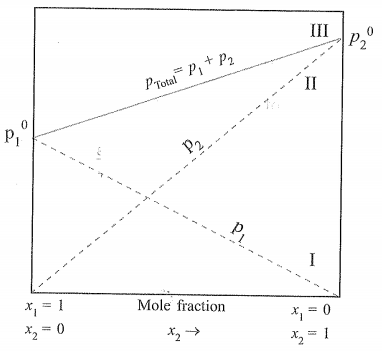
→ A plot of $p_1$ or $p_2$ versus the mole fractions $x_1$ and $x_2$ for a solution gives a linear plot as shown in Fig.
Image
→ These lines (I and II) pass through the points for which $x_1$ and $x_2$ are equal to unity.
→ Similarly the plot (line III) of $p_{\text {total }}$ versus $x_2$ is also linear Fig.
→ The minimum value of $p_{\text {Total }}$ is $p_1^o$ and the maximum value is $p_2^o$, assuming that component -1 is less volatile than component $-2\left(p_1^o < p_2^o\right)$
→ The composition of vapour phase in equilibrium with the solution is determined by the partial pressures of the components.
→ If $y_1$ and $y_2$ are the mole-fraction of the component 1 and 2 respectively in vapour phase then,
→ Using Dalton's Law of partial pressure
$\begin{array}{l}p_1=y_1 \cdot p_{\text {Total }} \\ p_2=y_2 \cdot p_{\text {Total }}\end{array}$
→ In general
$p_i=y_i\  p _{\text {Total }}$

Need a full question paper?

Generate a complete, print-ready paper with questions like this in minutes — across 16+ boards, with answer keys.

Start Generating Free