Question
Explain reactivity order towards $SN^2$ reaction of alkyl halides.

Answer

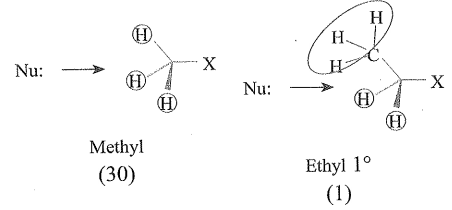
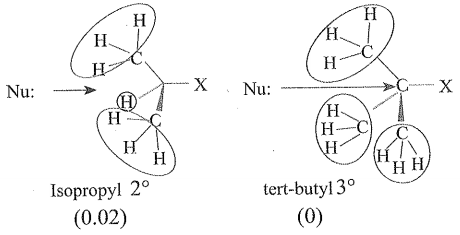
$\rightarrow$ Reactivity order of primary secondary and tertiary halides toward $SN^2$ reaction is $CH_3-X > 1^\circ -$ halide $>$ $2^\circ -$ halide $> 3^\circ -$ halide.
$\rightarrow$ The presence of bulky substituents on or near the carbon atom have a dramatic inhibiting effect.
$\rightarrow$ Of the simple alkyl halides, methyl halides react most rapidly in $SN^2$ reactions because there are only three small hydrogen atoms.
$\rightarrow$ Tertiary halides are the least reactive because bulky groups hinder the approach nucleophiles.
$\rightarrow$ Thus, the order of reactivity followed is: Primary halide $>$ Secondary halide $>$ Tertiary halide.
Image
Image

Need a full question paper?

Generate a complete, print-ready paper with questions like this in minutes — across 16+ boards, with answer keys.
Start Generating Free

Similar questions

Depict the galvanic cell in which the reaction: $Zn(s) + 2Ag^+(aq) → Zn^{2+}(aq) + 2Ag(s)$ takes place.
Further indicate what are the carriers of the current inside and outside the cell. State the reaction at each electrode.
Do the following conversions in not more than two steps:
  1. Propene to Acetone.
  2. Propanoic acid to 2-hydroxypropanoic acid.
Write structural formulas and names of four possible aldol condensation products from propanal and butanal. In each case, indicate which aldehyde acts as nucleophile and which as electrophile.
Why is the reactivity of all the three classes of alcohols with conc. $HCl$ and $ZnCl_2$ (Lucas reagent) different?
Short note: Sulphonation of Aniline.
Why $B$ complex vitamine compounds are essential for us? Describe their important sources.
Draw optical isomers of cis $\left[ PtCl _2( en )_2\right]$.
What are inner transition elements? Decide which of the following atomic numbers are the atomic numbers of the inner transition elements: 29, 59, 74, 95, 102, 104.
Give an example where physisorption changes to chemisorption with rise in temperature. Explain the reason for change.
Compound $‘A’$ was prepared by oxidation of compound $‘B’$ with alkaline $KMnO_4.$ Compound $‘A’$ on reduction with lithium aluminium hydride gets converted back to compound $‘B’.$ When compound $‘A’$ is heated with compound $B$ in the presence of $H_2SO_4$ it produces fruity smell of compound $C$ to which family the compounds $‘A’,\ ‘B’$ and $‘C’$ belong to?