Question
Explain reactivity order towards SN2 reaction of alkyl halides.
Answer

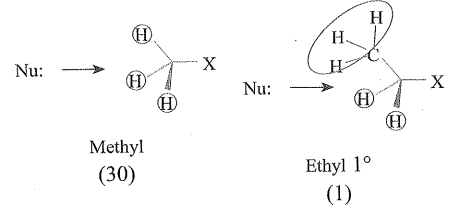
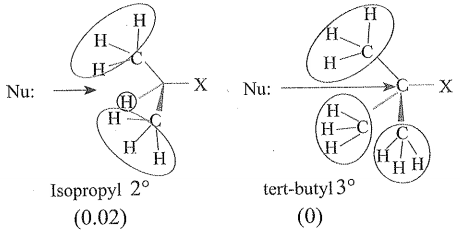
→ Reactivity order of primary secondary and tertiary halides toward SN2 reaction is CH3-X > 1º - halide > 2º - halide > 3º - halide.
→ The presence of bulky substituents on or near the carbon atom have a dramatic inhibiting effect.
→ Of the simple alkyl halides, methyl halides react most rapidly in SN2 reactions because there are only three small hydrogen atoms.
→ Tertiary halides are the least reactive because bulky groups hinder the approach nucleophiles.
→ Thus, the order of reactivity followed is: Primary halide > Secondary halide > Tertiary halide.
Image
Image

Need a full question paper?

Generate a complete, print-ready paper with questions like this in minutes — across 16+ boards, with answer keys.

Start Generating Free

Similar questions

Give the structures of A, B and C in the following reactions:

$\text{C}_6\text{H}_5\text{N}_2\text{Cl}\xrightarrow{\text{CuCN}\ \ }\text{A}\xrightarrow{\text{H}_2\text{O/H}^+\ \ }\text{B}\xrightarrow{\text{NH}_3;\Delta\ \ \ }\text{C}$

In a galvanic cell, the following cell reaction occurs:
Zn (s) + 2 Ag+ (aq) $\longrightarrow$ Zn2+ (aq) + 2 Ag (s) Eocell = + 1.56 V
  1. Is the direction of flow of electrons from zinc to silver or silver to zinc?
  2. How will concentration of Zn2+ ions and Ag+ ions be affected when the cell functions?
How will you bring the following conversions?
Phenol to aspirin.
For the decomposition of azoisopropane to hexane and nitrogen at 543 K, the following data are obtained.
t (sec) P(mm of Hg)
0 35.0
360 54.0
720 63.0
Calculate the rate constant.
The following results have been obtained during the kinetic studies of the reaction:

2A + B → C + D

Experiment [A]/mol L-1 [B]/mol L-1

Initial rate of formation of

D/mol L-1 min-1

I 0.1 0.1 6.0 × 10-3
II 0.3 0.2 7.2 × 10-2
III 0.3 0.4 2.88 × 10-1
IV 0.4 0.1 2.40 × 10-2
Determine the rate law and the rate constant for the reaction.

Give examples of the common names of carboxylic acid which are derived from Latin or Greek names of their natural sources.
Define native state in reference to protein.
If the value of rate constants are same for three reactions whose orders are 1,2 , and 3 , then what will be the order of the rates of these reactions if the value of concentration is 1 M , less than 1 M and more than 1 M ?
Explain giving reason:
The transition metals generally form coloured compounds.
