Question
Explain redox reactions on the basis of electron transfer. Give suitable examples.

Answer

Get the step-by-step solution for this question inside the Vidyadip app.

Get the answer in the app

Need a full question paper?

Generate a complete, print-ready paper with questions like this in minutes — across 16+ boards, with answer keys.
Start Generating Free

Similar questions

Explain oxidizing and reducing agents with examples.
Calculate the energy required for the process,
$\text{He}^+(\text{g})\rightarrow\text{He}^{2+}\text{(g)}+\text{e}^-$
The ionization energy for the H atom in the ground state is 2.18 × 10⁻¹⁸J atom–1
Explain why alkyl groups act as electron donors when attached to a $\pi$ system.
An alkene 'A' on ozonolysis gives a mixture of ethanal and pentan-3-one. Write structure and IUPAC name of 'A'.
Explain why CO2-3 ion cannot be represented by a single Lewis structure. How can it be best represented?
Discuss and compare the trend in ionisation enthalpy of the elements of group1 with those of group17 elements.
Draw diagrams showing the formation of a double bond and a triple bond between carbon atoms in C2H4 and C2H2 molecules.
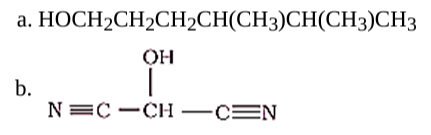
1. For each of the following compounds, write a condensed formula and also their bond-line formula.
Image
2. How does
i. an electron withdrawing group (EWG) and
ii. an electron donating group (EDG) influence the acid strength of carboxylic end?
  1. Define standard enthalpy of formation. Explain why the enthalpy changes for the reaction given below are not enthalpies of formation of CaCO3 and HBr:
  1. $\text{CaO(s)}+\text{CO}_2(\text{g})\overrightarrow{\ \ \ \ \ \ \ \ }\ \text{CaCO}_3(\text{s});$ $\Delta_\text{r}\text{H}^\circ=-178.3\text{kJ mol}^{-1}$
  2. ​​​​​​​$\text{H}_2(\text{g})+\text{Br}_2(\text{g})\overrightarrow{\ \ \ \ \ \ \ }\ 2\text{HBr(g)};$ $\Delta_\text{r}\text{H}^\circ=-72.8\text{kJ mol}^{-1}$
  1. Use the bond enthalpies listed below to determine the enthalpy of reaction:

$\ \ \ \ \ \ \ \ \text{H}\\ \ \ \ \ \ \ \ \ \ |\\\text{H}-\text{C}-\text{H(g)}+2\text{O}=\text{O(g)}\overrightarrow{\ \ \ \ \ }\ \text{O}=\text{C}=\text{O(g)}\\ \ \ \ \ \ \ \ \ \ |\\ \ \ \ \ \ \ \ \ \text{H}\\+2\text{H}-\text{O}-\text{H(g)}$

Bond enthalpy $(\Delta\text{H}^\circ)/\text{kJ mol}^{-1}$ of C=O = 741; C-H = 414; H-O = 464; O=O = 498.

What is the effect of the following processes on the bond order in N-, and O2?
  1. N2 → N+2 + e
  2. O2 → O+2 + e