Question
Explain reduction reaction of carboxylic acids.

Answer

→ Carboxylic acids are reduced to primary alcohols by lithium aluminium hydride or better with diborane. Diborane does not easily reduce functional groups such as ester, nitro, halo, etc. Sodium borohydride does not reduce the carboxyl group.
$R - COOH \xrightarrow[\text { (ii) } H _3 O ^{+}]{\text {(i) } LiAIH _4 / \text { ether } B _2 H _6} R - CH _2 OH$

Need a full question paper?

Generate a complete, print-ready paper with questions like this in minutes — across 16+ boards, with answer keys.
Start Generating Free

Similar questions

The decomposition of A into product has value of k as $4.5 \times 10^3 \mathrm{~s}^{-1}$ at $10^{\circ} \mathrm{C}$ and energy of activation $60 \mathrm{~kJ} \mathrm{~mol}^{-1}$. At what temperature would k be $1.5 \times 10^4 \mathrm{~s}^{-1}$ ?
Define conductivity and molar conductivity for the solution of an electrolyte.
Draw the shape of the following molecules:
  1. $H_2S_2O_{8.}$
  2. $XeF_2.$
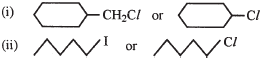
Which ones in the following pairs of substances undergoes $S_N2$ substitution reaction faster and why?
Give reasons for the following:Sulpha drugs work like antibiotics but they are not antibiotics.
The following results have been obtained during the kinetic studies of the reaction:
$2A + B → C + D$
Experiment $[A]/$mol $L^{-1}$ $[B]/$mol $L^{-1}$​​​​​​​ Initial rate of formation of

$D/mol\ L^{-1}$ min$^{-1}​​​​​​​$
$I$ $0.1$ $0.1$ $6.0 \times 10^{-3}$
$II$ $0.3$ $0.2$ $7.2 \times 10^{-2}$
$III$ $0.3$ $0.4$ $2.88 \times 10^{-1}$
$IV$ $0.4$ $0.1$ $2.40 \times 10^{-2}$​​​​​​​
Determine the rate law and the rate constant for the reaction.
Explain the displacement equation of diazonium group of benzene diazonium salt by iodide ion and chloride ion.
How do we separate two sulphide ores by Froth Floatation Method? Explain with an example.
Write the Nernst equation for the cell reaction in the Daniel cell. How will the $E_{Cell}$ be affected when concentration of $Zn^{2+}$ ions is increased?
Name the four bases present in DNA. Which one of these is not present in RNA?