Question
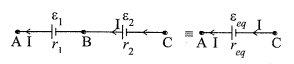
Explain series connection of cells. Derive the formula for equivalent emf and equivalent internal resistance for series connection of cell.
Answer

Image

The figure shows the series connection of two cells. The emf of two cells are $\varepsilon_1$ and $\varepsilon_2$ respectively and their internal resistences are $r_1$ and $r_2$ respectively. The current I is passing through this combination.

Need a full question paper?

Generate a complete, print-ready paper with questions like this in minutes — across 16+ boards, with answer keys.
Start Generating Free

Similar questions

X-ray and visible light travel at the same speed in vacuum. Do they travel at the same speed in glass?
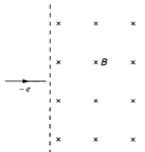
a. An electron moving horizontally with a velocity of $4 \times 10^4 m / s$ enters a region of uniform magnetic field of $10^{-5} T$ acting vertically upward as shown in the figure. Draw its trajectory and find out the time it takes to

Image

b. A straight wire of mass 200 g and length 1.5 m carries a current of 2 A. It is suspended in mid air by a uniform magnetic field B. What is the magnitude of the magnetic field?
The equation of refraction at a spherical surface is $\frac{\mu_2}{\text{v}}-\frac{\mu_1}{\text{u}}-=\frac{\mu_2-\mu_1}{\text{R}}.$ Taking $\text{R}=\infty,$ show that this equation leads to the equation $\frac{\text{Real depth}}{\text{Apparent depth}}=\frac{\mu_2}{\mu_1}$ for refraction at a plane surface.
A bulb is made using two filaments. A switch selects whether the filaments are used individually or in parallel. When used with a 15V battery, the bulb can be operated at 5W, 10W or 15W. What should be the resistances of the filaments?
A barometer is constructed with its tube having radius 1.0mm. Assume that the surface of mercury in the tube is spherical in shape. If the atmospheric pressure is equal to 76cm of mercury, what will be the height raised in the barometer tube. The contact angle of mercury with glass = 135º and surface tension of mercury = 0.465N/m. Density of mercury = 13600kg/m3.
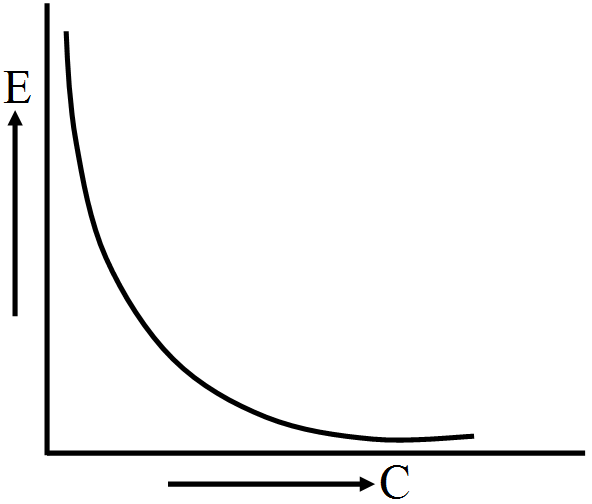
The graph shown here shows the variation of total energy (E) stored in a capacitor against the value of the capacitance (C) itself. Which of the two: the charge on capacitor or the potential used to charge it, is kept constant for this graph?

Answer the following question:
Why should gases be insulators at ordinary pressures and start conducting at very low pressures?
A high jumper successfully clears the bar. Is it possible that his centre of mass crossed the bar from below it? Try it with appropriate figures.
Draw a plot of the binding energy per nucleon as a function of mass number for a large number of nuclei, 2⩽ A⩽240. How do you explain the constancy of binding energy per nucleon in the range 30 < A < 170 using the property that nuclear force is short - ranged?
If the resultant torque of all the forces acting on a body is zero about a point, is it necessary that it will be zero about any other point?