Tamilnadu BoardEnglish MediumSTD 9ScienceBIOLOGY CH18 Organization of Tissues7 Marks
Question
Explain simple epithelium and its types.
✓
Answer
Simple Epithelium : 1. It is formed of a single layer of cells. It forms a lining for the body cavities and ducts. 2. Simple epithelium is further divided into the following types.
Squamous epithelium
Cuboidal epithelium
Columnar epithelium
Ciliated epithelium
Glandular epithelium
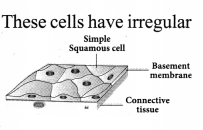
(i) Squamous epithelium :
It is made up of thin, flat cells with prominent nuclei. These cells have irregular boundaries and bind with neighbouring cells.
The squamous epithelium is also known as pavement membrane, which forms the delicate lining of the buccal cavity, alveoli of lungs, proximal tubule of kidneys, blood vessels etc.
It protects the body from mechanical injury, drying and invasion of germs.
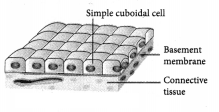
(ii) Cuboidal epithelium:
It is composed of single layer of cubical cells.
The nucleus is round and lies in the centre.
This tissue is present in the thyroid vesicles, salivary glands, sweat glands, exocrine pancreas.
It is also found in the intestine and tubular part of the nephron (kidney tubules) as microvilli that increase the absorptive surface area.
Their main function is secretion and absorption.
(iii) Columnar epithelium:
It is composed of a single layer of slender, elongated and pillar like cells.
Their nuclei are located at the base.
It is found lining the stomach, gall bladder, bile duct, small intestine, colon, oviducts and forms a mucous membrane. ‘
They are mainly involved in secretion and absorption.
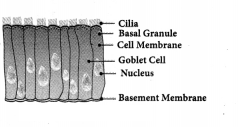
(iv) Ciliated epithelium :
Certain columnar cells bear numerous delicate hair like out growths called ilia and are called ciliated epithelium.
Their function is to move particles or mucus in a specific direction over the epithelium.
It is seen in the trachea of wind-pipe, bronchioles of respiratory tract, kidney tubules and fallopian tubes of oviducts.
(v) Glandular epithelium :
Epithelial cells are often modified to form specialized gland cells which secrete chemical substances at the epithelial surface.
This lines the gastric glands, pancreatic tubules and intestinal glands.
Need a full question paper?
Generate a complete, print-ready paper with questions like this in minutes — across 16+ boards, with answer keys.
 (iii) Columnar epithelium: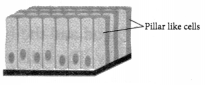
 (v) Glandular epithelium :