Question
Explain $SN ^1$ reaction with example.

Answer

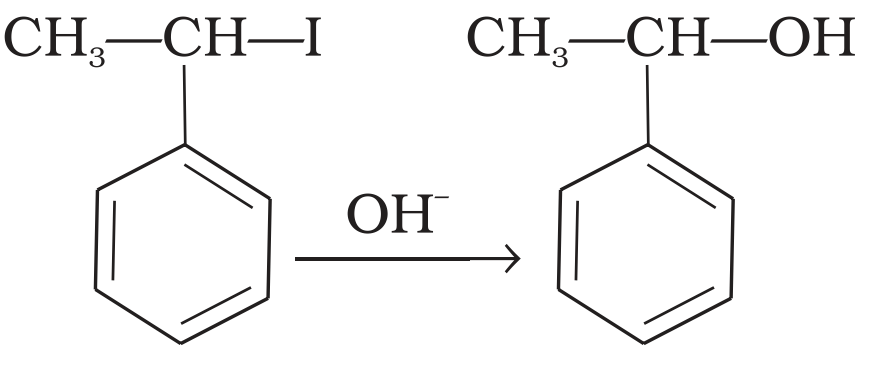
$S_N 1$ (Unimolecular Nucleophilic Substitution) Reaction
The $S_N 1$ reaction occurs in two steps and follows first-order kinetics. It is favored by tertiary alkyl halides due to the stability of the intermediate carbocation.
1. Step 1 (Slow): Formation of a stable carbocation by the loss of the leaving group.
2. Step 2 (Fast): Attack of the nucleophile on the carbocation.
Example: Hydrolysis of tert-butyl bromide with aqueous KOH .
$\left( CH _3\right)_3 C - Br + OH ^{-} \longrightarrow\left( CH _3\right)_3 C - OH + Br ^{-}$

Need a full question paper?

Generate a complete, print-ready paper with questions like this in minutes — across 16+ boards, with answer keys.

Start Generating Free

Similar questions

Explain (% V/V) Volume Percentage with examples.
Which is Rosenmund reduction?
Explain the preparation of aldehydes and ketones by dehydrogenation of alcohols with suitable examples.
Write the name of the cell which is generally used in transistors. Write the reactions taking place at the anode and the cathode of this cell.
The reaction of alkyl chloride with aquons KOH produces an alcohol, while the reaction with alcoholic КОН produces an alkene. Explain why and write the chemical equations for both reactions
Why is it more important to take CaCl2 instead of NaCl to remove snow accumulated on roads?
Calculate the half-life of a first order reaction from their rate constants given below :
(i) $200$ $s^{-1}$
(ii) $2$ $min^{-1}$
(iii) 4 year $^{-1}$
The following is not an appropriate reaction for the preparation of tert.-butyl ethyl ether:
$\text{C}_2\text{H}_5\text{ONa}+(\text{CH}_3)_3\text{C}-\text{Cl}\rightarrow(\text{CH}_3)_3\text{C}-\text{OC}_2\text{H}_5$
What would be the major product of the given reaction?
A solution is prepared by dissolving 11 g glucose in $200 cm^3$ water at $30^{\circ} C$. What is the mass Percentage of glucose in solution? The density of water $30^{\circ} C$ is $0.996 g / cm ^3$