Question
Explain Solid-liquid equilibrium.

Answer

Conversion of ice to water is an example of solid-liquid equilibrium.
$\underset{\text { ice }}{ H _2 O ( s )} \rightleftharpoons \underset{\text { water }}{ H _2 O (l)}$
In a container (thermos flask) at 273 K temperature and on one atmospheric pressure, ice and water are in equilibrium. 273 K , is the melting point of ice and freezing point of water. At equilibrium, with time there is no change in mass of ice and water. Because rate of formation of water from ice is equal to rate of formation of ice from water.

Need a full question paper?

Generate a complete, print-ready paper with questions like this in minutes — across 16+ boards, with answer keys.

Start Generating Free

Similar questions

How many electrons will be present in the subshells having ms value of $-\frac{1}{2}$ for $\mathrm{n}=4$ ?
Assign oxidation number to the underlined elements in the following species:$\text{H}_4\text{P}_2\text{O}_7$
How many atoms of magnesium are present in 96u of Mg?
The first $(\Delta_{1}\text{H}_{1})$ and the second $(\Delta_{1}\text{H}_{1})$ ionization enthalpies (in $\mathrm{kJ} \mathrm{~mol}^{-1}$ ) and the $(\Delta_{1}\text{H}_{1})$ electron gain enthalpy (in $\mathrm{kJ} \mathrm{~mol}^{-1}$ ) of a few elements are given below:
Elements $\Delta\text{H}_{1}$ $\Delta{\text{H}}_{2}$ $\Delta_{\text{eg}}\text{H}$
I 520 7300 -60
II 419 3051 -48
III 1681 3374 -328
IV 1008 1846 -295
V 2372 5251 +48
VI 738 1451 -40
Which of the above elements is likely to be:
The metal which can form a stable binary halide of the formula $\mathrm{MX}_2(\mathrm{X}=$ halogen $)$.
What will be the main product when sec. butyl chloride react with alc. KOH ? Write the equations of it.
$\text{N}_2+\text{3H}_2\rightleftharpoons2\text{NH}_3+\text{Heat}$ What is the effect of increasing temperature on value of K?
A LPG cylinder contains 15kg of butane at 27°C and 10atm pressure is leaking. After one day, its pressure decreased to 8atm. Calculate the quantity of gas leaked.
Use the periodic table to answer the following questions.
Identify an element that would tend to gain two electrons.
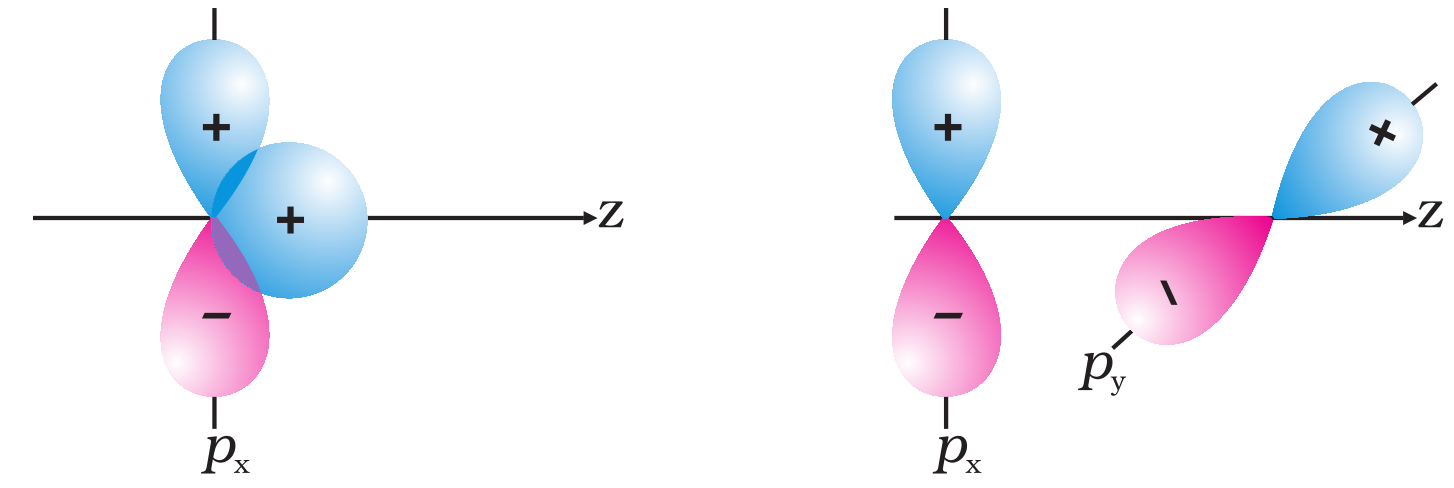
Why does type of overlap given in the following figure not result in the bond formation?
Predict the dipole moment of:
  1. A molecule of the type $\mathrm{AX}_2$ having a linear geometry.
  2. A molecule of the type $\mathrm{AX}_4$ having tetrahedral geometry.
  3. A molecule of the type $\mathrm{AX}_2$ having angular geometry.
  4. A molecule of the type $\mathrm{AX}_4$ having square planar geometry.