Maharashtra BoardEnglish MediumSTD 11 SciencePhysicsOptics4 Marks
Question
Explain spherical aberration for spherical mirrors. How can it be minimized? Can it be eliminated by some curved mirrors?
✓
Answer
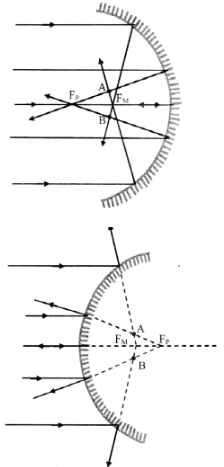
In case of spherical mirrors (excluding small aperture spherical mirror), The rays coming from a distant object farther from principal axis do not remain parallel to the axis. Thus, the focus gradually shifts towards the pole.
The assumption for clear image formation namely, ‘If there is a parallel beam of rays, it is paraxial, i.e., parallel and close to the principal axis’, is not followed in this case.
The relation $f \left( f =\frac{R}{2}\right)$ giving a single point focus is not followed and the image does not get converged at a single point resulting into a distorted or defective image.
This phenomenon is known as spherical aberration.
It occurs due to spherical shape of the reflecting surface, hence known as spherical aberration.
The rays near the edge of the mirror converge at focal point $F_M$ Whereas, the rays near the principal axis converge at point $F_P$. The distance between $F_M$ and $F_P$ is measured as the longitudinal spherical aberration.
In spherical aberration, single point image is not possible at any point on the screen and the image formed is always a circle.
At a particular location of the screen (across AB in figure), the diameter of this circle is minimum. This is called the circle of least confusion. Radius of this circle is transverse spherical aberration.
Remedies for Spherical Aberration:
Spherical aberration can be minimized by reducing the aperture of the mirror.
Spherical aberration in curved mirrors can be completely eliminated by using a parabolic mirror.
Need a full question paper?
Generate a complete, print-ready paper with questions like this in minutes — across 16+ boards, with answer keys.