Question
Explain ẞ Elimination reaction with example. ### Explain Dihydrohalogenation reaction of Haloalkane ### Explain zaitsev or Saytzeff rule with example.

Answer

→ When a haloalkane with ẞ-hydrogen atom is heated with alcoholic solution of potassium hydroxide, there elimination of hydrogen atom from ẞcarbon and a halogen atom from the a-carbon atom.
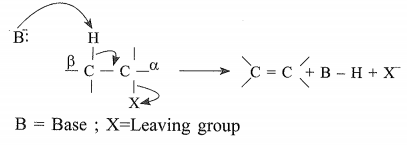
Image
→ As a result, an alkene is formed as a product. Since ẞ-hydrogen atom is involved in elimination, it is ofte called ẞ-elimination.

Image
→ If there is possibility of formation of more than one alkene due to the availability of more than one ẞ-hy drogen atoms, usually one alkene is formed as the major product.
→ These form part of a pattern was first observed by Russian chemist, Alexander Zaitsev (also pronounced Saytzeff).
→ A rule which can be summarised as "in dehydrohalogenation reactions, the preferred product is that alken which has the greater number of alkyl groups attached to the doubly bonded carbon atoms."

Image
→ Thus, 2-bromopentane gives pent-2-ene as the major product.

Need a full question paper?

Generate a complete, print-ready paper with questions like this in minutes — across 16+ boards, with answer keys.

Start Generating Free

Similar questions

Complete the following chemical equations$:$
  1. $\ce{Cr_2O_7^{2-} + 6 Fe^{2+} + 14H^+\rightarrow}$
  2. $\ce{2CrO^{2-}{}_{4 } + 2H^+\rightarrow}$
  3. $\ce{2MnO^-_{4 } + 5C_2O_4^{2- } + 16H^+\rightarrow}$
For a reaction $2 H _2 O _2 \frac{ I ^{-}}{\text {alkaline medium }} 2 H _2 O + O _2$
the proposed mechanism is as given below:
(1) $H_{2}O_{2}+I^{-}\rightarrow H_{2}O+IO^{-}$ (slow)
(2) $H_{2}O_{2}+IO^{-}\rightarrow H_{2}O+I^{-}+O_{2}$ (fast)
(i) Write rate law for the reaction.
(ii) Write the overall order of reaction.
(iii) Out of steps (1) and (2), which one is rate determining step?
The decomposition of A into product has value of k as $4.5\times10^{3}s^{-1}$ at $10^{\circ}C$ and energy of activation $60~kJ~mol^{-1}$. At what temperature would k be $1.5\times10^{10}s^{-1}$?
Calculate the half-life of a first order reactions from their rate constants given below :
(a) $200~s^{-1}$
(b) $2~min^{-1}$
(c) $4~year^{-1}$
The rate constant for the decomposition of ethyl iodide $\ce{C_2H_5l(g) \rightarrow C_2H_4(g)+Hl(g)}$
at $600K$ is $1.60 \times 10^{-5} s^{-1} .$ Its energy of activation is $\ce{209 kJ/mol}.$ Calculate the rate constant of the reaction at $700K.$
Compound with molecular formula $C _4 H _8 O$ reacts with hydrazine and gives hydrazone. It forms iodoform by the reaction with iodine and NaOH but does not react with Fehling solution. Give the structure of this compound and required equations.
A solution prepared by dissolving 8.95mg of a gene fragment in 35.0mL. of water has an osmotic pressure of 0.335 torr at 25°C. Assuming that the gene fragment is a non-electrolyte, calculate its molar mass.
Give equations required for the following changes:
(i) Ethanal to methanamine
(ii) Ethanocyl chloride to methanamine
(iii) Ethanoic acid to propan-1-amine.
Give the principle of the manufacture of nitric acid from ammonia?
Define the term solution. How many types of solutions are formed? Write briefly about each type with an example.