Question
Explain standard hydrogen electrode. (SHE)

Answer

→ Standard Hydrogen Electrode works as a reference electrode for other half cells.
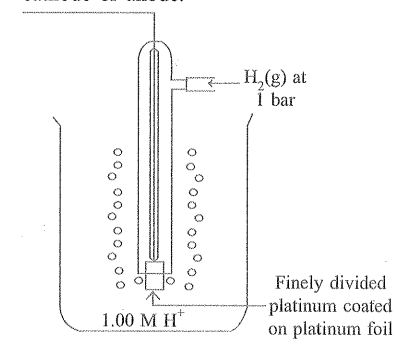
→ The standard hydrogen electrode consists of a platinum electrode coated with platinum black. The electrode is dipped in an acidic solution and pure hydrogen gas bubbled through it.
→ The concentration of both the reduced and oxidised forms of hydrogen is maintained at unity.
→ This implies that the pressure of hydrogen gas is one bar and the concentration of hydrogen ion in the solution is one molar.
→ When this half cell connected to other half cells, To form a complete all, The SHE can acts as as cathode or anode
Image
→ If it acts as cathode the following reduction reaction takes place on the platinum strip
$H ^{+}( aq )(1 M )+ e ^{-} \rightleftharpoons \frac{1}{2} H _2(g, 1 bar )$
→ If it acts as anode the oxidation reaction takes places on the anode
$\frac{1}{2} H _2(g, 1$ bar $) \rightleftharpoons H ^{+}( aq , 1 M )+ e ^{-}$
→ Electrode potential of Standard Hydrogen gas Electrode is accepted zero at all temperature.

Need a full question paper?

Generate a complete, print-ready paper with questions like this in minutes — across 16+ boards, with answer keys.

Start Generating Free

Similar questions

A 5% solution (by mass) of cane sugar in water has freezing point of 271K. Calculate the freezing point of 5% glucose in water if freezing point of pure water is 273.15 K.
The rate of a particular reaction triples when temperature changes from 50°C to 100°C. Calculate the activation energy of the reaction.

[log 3 = 0.4771; R = 8.314 JK-1 mol-1].

Write down the IUPAC name for the following complex and indicate the oxidation state, electronic configuration and coordination number. Also give stereochemistry and magnetic moment of the complex:
[Co(NH3)5Cl-]Cl2
Differentiate between rate of reaction and reaction rate constant.
When a chromite ore (A) is fused with sodium carbonate in free excess of air and the product is dissolved in water, a yellow solution of compound (B) is obtained. After treatment of this yellow solution with sulphuric acid,compound (C) can be crystallised from the solution. When compound (C) is treated with KCl, orange crystals of compound (D) crystallise out. Identify A to D and also explain the reactions.
CCl4 and water are immiscible whereas ethanol and water are miscible in all proportions. Correlate this behaviour with molecular structure of these compounds.CCl4 is a non-polar covalent compound, whereas water is a polar compound. CCl4 can neither form hydrogen bonds with water molecules nor can it break hydrogen bonds between water molecule, therefore, it is insoluble in water. Ethanol is a polar compound and can form hydrogen bonds with water, which is a polar solvent, therefore it is miscible with water in all proportions.
Aqueous copper sulphate solution and aqueous silver nitrate solution are electrolysed by 1 ampere current for 10 minutes in separate electrolytic cells. Will the mass of copper and silver deposited on the cathode be same or different? Explain your answer.
Write a note on halogenation of phenol.
For a weak electrolyte, molar conductance in dilute solution increases sharply as its concentration in solution is decreased. Give reason.
Write short notes :
Coupling reaction