S
N2 reaction:
→ In case of optically active alkyl halides, the product formed as a result of S
N 2 mechanism has the inverted configuration as compared to the reactant.
→ This is because the nucleophile attaches itself on the side opposite to the one where the halogen atom is present.
→ When (-)-2-bromooctane is allowed to react with sodium hydroxide, (+)-octan-2-ol is formed with the OH group occupying the position opposite to what bromide had occupied.
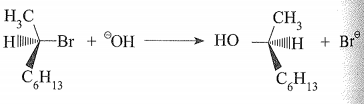
→ Thus S
N2 reactions of optically active halides are accompanied by inversion of configuration. SN
1 reaction:
→In case of optically active alkyl halides, SN
1 reactions are accompanied by racemisation.
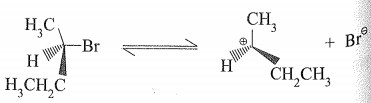
→ Actually the carbocation formed in the slow step being SP
2 hybridised is planar (achiral).
→ The attack of the nucleophile may be accomplished from either side of the plane of carbocation resulting in a mixture of products,
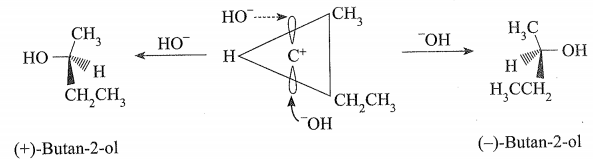
→ One having the same configuration (the
-OH attaching on the same position as halide ion) and the other having opposite configuration (the
-OH attaching on the side opposite to halide ion).
→ This may be illustrated by hydrolysis of optically active 2-bromobutane, which results in the formation of (±)-butan-2-ol.