Question
Explain stereochemistry of SN1 and SN2 reaction.

Answer

SN2 reaction:
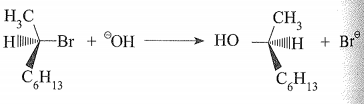
→ In case of optically active alkyl halides, the product formed as a result of SN 2 mechanism has the inverted configuration as compared to the reactant.
→ This is because the nucleophile attaches itself on the side opposite to the one where the halogen atom is present.
→ When (-)-2-bromooctane is allowed to react with sodium hydroxide, (+)-octan-2-ol is formed with the OH group occupying the position opposite to what bromide had occupied.
Image
→ Thus SN2 reactions of optically active halides are accompanied by inversion of configuration. SN1 reaction:
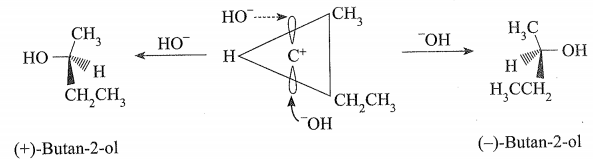
→In case of optically active alkyl halides, SN1 reactions are accompanied by racemisation.
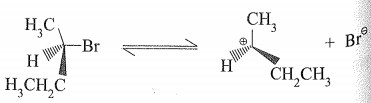
→ Actually the carbocation formed in the slow step being SP2 hybridised is planar (achiral).
→ The attack of the nucleophile may be accomplished from either side of the plane of carbocation resulting in a mixture of products,
Image
Image
→ One having the same configuration (the -OH attaching on the same position as halide ion) and the other having opposite configuration (the -OH attaching on the side opposite to halide ion).
→ This may be illustrated by hydrolysis of optically active 2-bromobutane, which results in the formation of (±)-butan-2-ol.
Need a full question paper?

Generate a complete, print-ready paper with questions like this in minutes — across 16+ boards, with answer keys.

Start Generating Free

Similar questions

Explain colour in coordination compounds.
State the preparation, properties and uses of ethanol.
Define conductivity and molar conductivity for the solution of an electrolyte. Discuss their variation with concentration.
Read the following text carefully and answer the questions that follow:
The actinoids include the fourteen elements from Th to Lr. The actinoids are radioactive elements and the earlier members have relatively long half-lives, the latter ones have half-life values ranging from a day to 3 minutes for lawrencium. The latter members could be prepared only in nanogram quantities. Actinoids show a greater range of oxidation states. The elements, in the first half of the series frequently exhibit higher oxidation states. The actinoids resemble the lanthanoids in having more compounds in +3 state than in the +4 state. All the actinoids are believed to have the electronic configuration of 7s2 and variable occupancy of the 5f and 6d subshells. The magnetic properties of the actinoids are more complex than those of the lanthanoids. The variation in the magnetic susceptibility of the actinoids with the number of unpaired 5f electrons is roughly parallel to the corresponding results for the lanthanoid.
i. Actinoid contraction is greater from element to element than lanthanoid contraction. Why?
ii. Actinoids show irregularities in their electronic configuration. Justify?
iii. The actinoid metals are all silvery in appearance but display a variety of structures than lanthanoid give reason.
OR
iii. The magnetic properties of the actinoids are more complex than those of the lanthanoids. Why?
Write one chemical equation to illustrate the following reactions :
(i) Aldol condensation,
(ii) Cannizzaro's reaction.
How will you bring about the following transformations: (i) Butan-1-ol to butanoic acid,
(ii) Benzyl alcohol to phenyl ethanoic acid,
(iii) Bromobenzene to benzoic acid,
(iv) Cyclohexene to hexane-1, 6-dioic acid.
Vapour pressure of water at 293 K is 17.535 mm Hg. Calculate the vapour pressure of water at 293 K when 25 g of glucose is dissolved in 450 g of water.
Mention the factors that affect the rate of a chemical reaction.
Derive nernst equation for Daniel cell