Question
Explain:
  1. Stratification.
  2. Leaching.

Answer

  1. Stratification: It is the venical distribution of different species occupying different levels in an ecosystem, e.g. trees occupy top vertical strata or layer of a forest, shrubs the second and herbs and grasses occupy the bonom (third) layers.

  2. Leaching: It is the process by which water-soluble inorganic nutrients go down into the soil horizon and get precipitated as unavailable salts.

Need a full question paper?

Generate a complete, print-ready paper with questions like this in minutes — across 16+ boards, with answer keys.
Start Generating Free

Similar questions

  1. What happens when Meloidegyne incognitia consumes cells with RNAi gene?
What will be the effect if unprocessed preinsulin is given to diabetic patients?
A diploid organism is heterozygous for 4 loci, how many types of gametes can be produced ?
What happens to an individual when a regular dose of drugs/alcohol is abruptly discontinued? What characteristics manifest in the individual under such a situation?
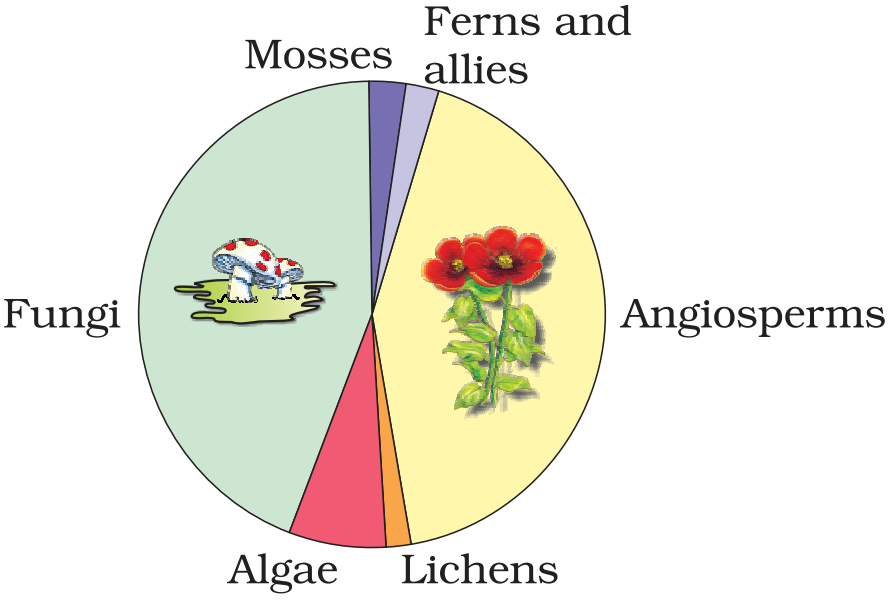
Observe the global biodiversity distribution of the major plant taxa in the given diagram and answer the questions accordingly.

  1. Which group of plants are the most endangered?
  2. Why are mosses/ ferns so few? Give reason.
  3. How do fungi that are heterotrophs sustain themselves as a large population? 
  4. Which group of plants is most advanced and which one is most primitive?
Climax stage is achieved quickly in secondary succession as compared to primary succession. Why?
Explain what happens in frameshift mutation. Name one disease caused by the disorder.
Put these statements in the proper order, by rearranging the letters, to describe Darwin's theory of natural selection-
  1. The end result of organic evolution is many different species, each adapted to specific environments.
  2. Many more individuals are produced each generation that can survive and reproduce.
  3. Gradually, over long periods of time, a population can become well adapted to a particular environment.
  4. There are inheritable variation among the members of a population.
  5. Individuals with adaptive characteristics are more likely to be selected to reproduce by the environment.
How many sperms will be produced from 100 primary spermatocytes and how many eggs will be produced from 100 primary oocytes?
Define spermiogenesis. Where does it occur?