Question
Explain structure of modern periodic table in short.

Answer

  1. The modern periodic table consists of seven horizontal rows called the periods and eighteen vertical columns called the groups.
  2. The arrangement of the periods and groups results in the formation of boxes, where each box corresponds to the position of an element.
  3. Atomic numbers are serially indicated in the upper part of these boxes.
  4. In addition to these seven rows, lanthanide and actinide series are shown separately at the bottom of the periodic table. The first row is lanthanide series and the second row is actinide series.
  5. There are 118 boxes in the periodic table including the two series. vi. The entire periodic table is divided into four blocks: s-block, p-block, d-block and f-block.
  6. s-block: contains group 1 and 2 elements
    p-block: contains group 13 to 18 elements
    d-block: contains group 3 to 12 elements (transition elements)
    f-block: contains lanthanide and actinide series
  7. A zig-zag line is drawn in the p-block of the periodic table. Metals lie on the left side while nonmetals lie on the right side of this line. Metalloids lie along the border of this line.

Need a full question paper?

Generate a complete, print-ready paper with questions like this in minutes — across 16+ boards, with answer keys.

Start Generating Free

Similar questions

Construction of a compound microscope:
(1) A compound microscope consists of a metal tube fitted with two convex lenses at the two ends. These lenses are called the objective lens (the lens directed towards the object) and the eyepiece (the lens directed towards the eye). Both the lenses are small in size, but the cross section of the objective lens is less than that of the eyepiece. The objective lens has a short focal length. The focal length of the eyepiece is more than that of the objective lens.(2) The metal tube is mounted on a stand. The principal axes of the objective lens and the eyepiece are along the same line. The distance between the object and the objective lens can be changed with a screw. It is possible to change the distance between the objective lens and the eyepiece.
Working:
(1) The object to be observed is illuminated and placed in front of the objective lens, slightly beyond the focal length of the objective lens. Its real, inverted and enlarged image is formed by the, objective lens on the other side.
(2) This intermediate image lies within the focal length of the eyepiece. It serves as an object for the eyepiece. The eyepiece works as a simple microscope. The final image is virtual, highly enlarged and inverted with respect to the original object. It can be formed at the minimum distance of distinct vision from the eyepiece. The final image is observed by keeping the eye close to the eyepiece.
Use: This microscope is used to observe blood cells, microorganisms, etc.
1.In a compound microscope, which lens has greater focal length?
2.Where do you place the object to be observed with a compound microscope?
3.State which distance is adjusted to observe the object with a compound microscope.
4.State the nature of the final image in compound microscope relative to the object.
5.State the use of a compound microscope.
In a village, farmers started cultivating crops all around a lake which was always filled with water. They added lot of materials W to the soil in their fields to increase the yield of crops. Soon they found that the whole surface of water in the lake was covered with a green layer made up of tiny organisms X. After some time, the fish present in the lake started dying in large numbers because they could not get sufficient Y due to a process Z which had occurred in lake water and drained out all the Y present in the water of lake.
  1. What do you think materials W are?
  2. Name (i) X, and (ii) Y?
  3. What is the process Z known as?
  4. What happens during the process Z which uses up all the Y present in lake water?
  5. What does this example tell us about the use of materials like W?
A solid substance $P$ which is very hard is used in the construction of many buildings, especially flooring. When substance $P$ is heated strongly, it decomposes to form another solid $ Q$ and a gas $R$ is given out. Solid $Q$ reacts with water with the release of a lot of heat to form a substance S. When gas $R $ is passed into a clear solution of substance $S,$ then a white precipitate of substance $T$ is formed. The substance $T$ has the same chemical composition as starting substance $P.$
  1. What is substance $P?$ Write its common name as well as chemical formula.
  2. What is substance $Q?$
  3. What is gas $R?$
  4. What is substance $S?$ What is its clear solution known as$?$
  5. What is substance $T?$ Name any two natural forms in which substance T occurs in nature.
The organ A which is located inside the skull of our body is protected by a bony shell B. It is surrounded by three layers membranes C. The spaces between these layers are filled with a liquid D which protects organ A from mechanical shocks. Organ A in combination with another organ E makes up the central nervous system.
  1. What is organ A?
  2. What are B, C and D?
  3. Name the organ E.
  4. While walking barefoot, if we happen to step on a sharp piece of stone, we immediately lift our foot up. Which of the two organs: A or E, is directly involved in this action?
  5. If we step out from a darkened room into bright sunlight, we close our eyes for a moment. Which of the two organs: A or E, is directly involved in this action?
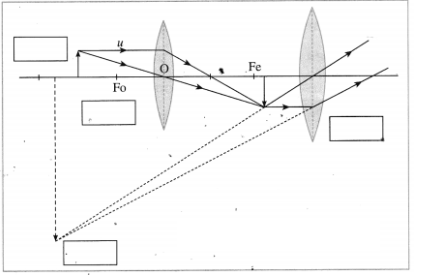
(i) Which type of microscope has the arrangement of lenses shown in the following figure?
Image
(ii) Label the figure correctly.
(iii) Write the working of this microscope.
(iv) Where is this microscope used?
(v) Suggest a way to increase the efficiency of this microscope.
What happens when a ray of light is incident normal to the interface between two media? Draw the corresponding neat and labelled diagram.
What does the central nervous system in humans consist of? What is the job of the central nervous system?
X and Y are two human beings. The organ A in the reproductive system of X releases a mature gamete B once a month which goes into a tube-like structure C through a funnel-like opening. The organ D in the reproductive system of Y makes and releases gametes E which pass through a duct F and are introduced by an organ of Y, into the body of X. B and E fuse together in C to form a new cell G. The cell G divides repeatedly to form a ball of cells H which gets embedded in the lining of organ I of reproductive system of X where it grows and develops into a baby.
  1. Name (i) organ A, and (ii) gamete B.
  2. Write two names of tube-like structure C.
  3. Name (i) organ D, and (ii) gamete E.
  4. Write two names of duct F.
  5. Name (i) cell G (ii) ball of cells H, and (iii) organ I.
  6. Out of X and Y, which one is (i) male, and (ii) female?
Generally the ionic compounds have high melting points.
Calculate the combined resistance in each case:
