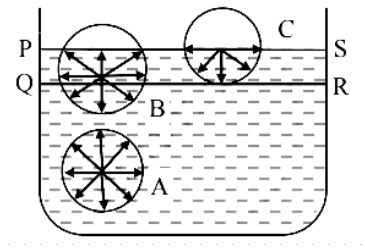
Molecular theory of surface tension:
i. Let PQRS = Surface film of liquid in a container containing liquid. PS is the free surface of the liquid and QR is the inner layer parallel to PS at distance equal to the range of molecular force.
ii.Now consider three molecules A, B, and C in a liquid in a vessel such that molecule A is well inside the liquid, molecule B within the surface film, and molecule C is on the surface of the liquid as shown in the figure.
iii.The sphere of influence of molecule A is entirely inside the liquid. As a result, molecule A is acted upon by equal cohesive forces in all directions. Thus, the net cohesive force acting on molecule A is zero.
iv.For molecule B, a large part of its sphere of influence is inside the liquid and a smaller part is outside the surface (in the air). The adhesive force acting on molecule B due to air molecules above it and within its sphere of influence is weak compared to the strong downward cohesive force acting on the molecule. As a result, molecule B gets attracted inside the liquid.
V.For molecule C, half of the sphere of influence is in air and half is in liquid. As the density of air is much less than that of liquid, the number of air molecules within the sphere of influence of molecule C above the free surface of the liquid is much less than the numbers of liquid molecules within the sphere of influence that lies within the liquid. Thus, the adhesive force due to the air molecules acting on molecule C is weak compared to the cohesive force acting on the molecule. As a result, molecule C also gets attracted inside the liquid.
vi.Thus, all molecules in the surface film are acted upon by an unbalanced net cohesive force directed into the liquid. Therefore, the molecules in the surface film are pulled inside the liquid. This minimizes the total number of molecules in the surface film. As a result, the surface film remains under tension. The surface film of a liquid behaves like a stretched elastic membrane. This tension is known as surface tension and the force due to it acts tangential to the free surface of a liquid.