Question
  1. Explain taking one example of vertebrates anatomy that evolution of life has occurred on earth.
  2. 'Nature selects for fittest.' Explain with suitable examples.

Answer

  1. The forelimbs of cheetah, bats and human have a similar anatomical structure. These have bones, humerus, radius, ulna, carpals, metacarpals and phalanges. It indicates divergent evolution, where the same structure has developed along different directions as adaption to different needs. Such structures are called homologous organs and homology indicates common ancestry.
  2. The members of a population vary in characteristics even though they look similar. The population will increase exponentially but the natural resources are limited leading to more competition. The individuals which are fit and adapt themselves are able to survive. They grow reproduce and survive. This is called natural selection by Darwin.

Need a full question paper?

Generate a complete, print-ready paper with questions like this in minutes — across 16+ boards, with answer keys.

Start Generating Free

Similar questions

Describe the components of an ecosystem
Ramesh visited a National Park on a school trip where he saw tiger eating a deer. He got disturbed and asked his teacher why is he doing so. His teacher replied that it is natural population controlling phenomenon.
  1. Which type of interspecific interaction is found between tiger and deer?
  2. State the role of predators.
  3. What other type of population interactions are seen in nature?
  4. State the values of Ramesh towards animals.
  1. Represent diagrammatically three kinds of age-pyramids for human populations.
  2. How does an age pyramid for human population at given point of time helps the policymakers in planning for future?
  1. What is hydrarch succession?
  2. Compare the pioneer species and climax communities of hydrarch and xerarch succession respectively.
  3. List the factors upon which the type of invading pioneer species depend in secondary hydrarch succession. Why is the rate of this succession faster than that of primary succession?
What functions do the female reproductive system perform?
Answer the following questions:
Draw a diagrammatic sectional view of the female reproductive system of human and label the parts:
  1. Where the secondary oocytes develop.
  2. Which helps in collection of ovum after ovulation.
  3. Where fertilisation occurs.
  4. Here implantation of embryo occurs.
Answer the following questions:
Explain the role of pituitary and the ovarian hormones in menstrual cycle in human females.
Describe the structure of a ribosome, taking into consideration, its role in protein synthesis.
Draw a diagrammatic sketch of the sectional view of a typical anatropous ovule.
OR

Draw a labelled diagram of the sectional view of a typical anatropous ovule.

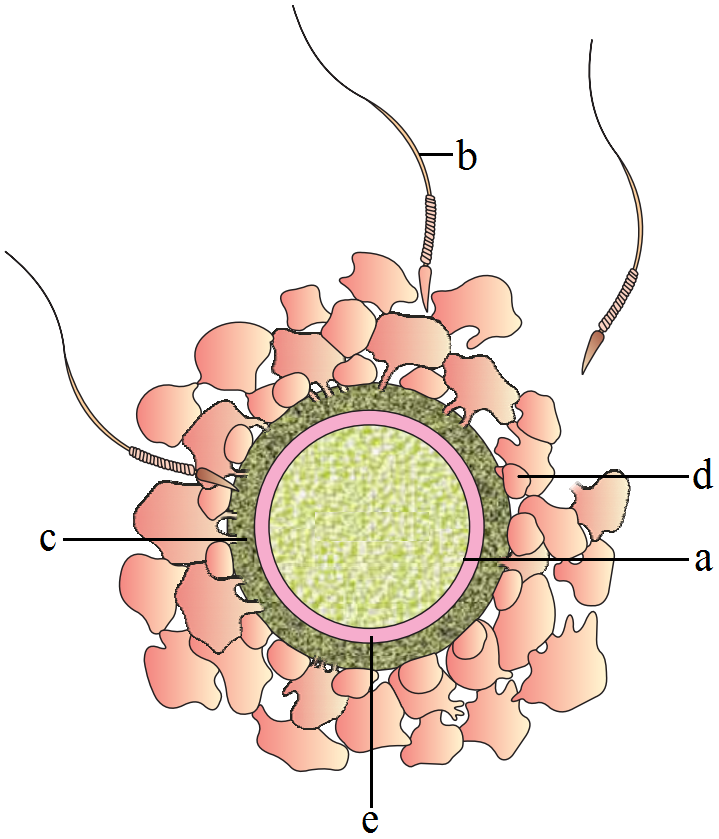
Study the illustration given and answer the questions that follow:

Name and state the function of ‘c’.