Question
  1. Explain taking one example of vertebrates anatomy that evolution of life has occurred on earth.
  2. 'Nature selects for fittest.' Explain with suitable examples.

Answer

  1. The forelimbs of cheetah, bats and human have a similar anatomical structure. These have bones, humerus, radius, ulna, carpals, metacarpals and phalanges. It indicates divergent evolution, where the same structure has developed along different directions as adaption to different needs. Such structures are called homologous organs and homology indicates common ancestry.
  2. The members of a population vary in characteristics even though they look similar. The population will increase exponentially but the natural resources are limited leading to more competition. The individuals which are fit and adapt themselves are able to survive. They grow reproduce and survive. This is called natural selection by Darwin.

Need a full question paper?

Generate a complete, print-ready paper with questions like this in minutes — across 16+ boards, with answer keys.

Start Generating Free

Similar questions

In a field of sugarcane, all the plants have been damaged during an epidemic of a fungal disease, whereas, in another field in the same area, there were many plants that were not affected by the disease.
  1. Explain the reason for this observation.
  2. An expert explains to the farmer, how the unaffected plants can be used to increase their number. Can you enumerate them?
  3. Is there any method to recover disease-free plant from diseased ones.
  4. What values are shown by the expert?
  1. You are given tall pea plants with yellow seeds, whose genotypes are unknown. How would you find the genotype of these plants? Explain with the help of cross.
  2. Identify A, B and C in the table given below:
Pattern of Inheritance
Monohybrid $F_1$ Phenotypic Expression
Codominance
‘A’
‘B’
Progeny resembled only one of the parents.
Incomplete dominance.
‘C’
Describe the functions of the following:
Trophoblast.
(i) Define translation.
(ii) Explain the translation process.
(iii) Draw a labelled diagram of the translation.
Differentiate between microsporogenesis and megasporogenesis. Which type of cell division occurs during these events? Name the structures formed at the end of these two events.
Read the following and answer any four questions from (i) to (v) given below:
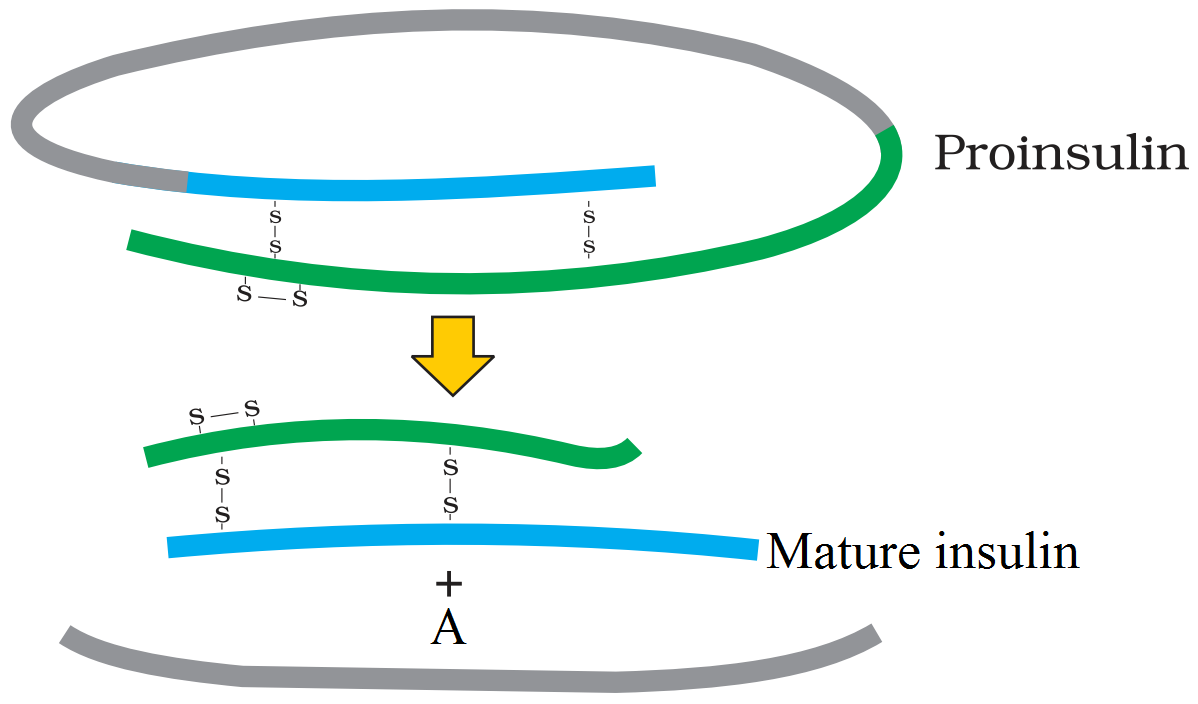
Insulin used to cure diabetes was earlier extracted from pancreas of slaughtered cattle and pigs. Insulin extracted from an animal source, though caused some patients to develop allergy or other types of reactions to the foreign protein. Human insulin consists of two short polypeptide chains : chain A and chain B, that are linked together by disulphide bridges. In mammals including humans, insulin is synthesised as a pro-hormone which contains an extra stretch called the C-peptide. This C peptide is not present in mature insulin and is removed during maturation into insulin.
  1. Identify A in the given figure.
  1. Polypeptide chain A.
  2. Polypeptide chain B.
  3. Polypeptide chain C.
  4. None of these.
  1. The following is a list of some stages involved in producing human insulin from genetically engineered bacteria.
  1. The bacteria are cultured in a fermenter for large scale production.
  2. Recombinant insulin is extracted from the bacterial cells that expresses insulin gene.
  3. The same restriction enzyme is used again to cut the bacterial plasmid for insertion of the human insulin gene.
  4. Bacteria take up the plasmid carrying the insulin gene.
  5. A restriction enzyme is used to cut human DNA to extract the insulin gene.
Select the correct order of these stages.
  1. 1, 5, 3, 4, 2
  2. 2, 4, 3, 5, 1
  3. 4, 5, 3, 2, 1
  4. 5, 3, 4, 1, 2
  1. To insert the insulin gene into bacterial DNA, both the bacterial plasmid and the human chromosome containing the insulin gene are treated with the same restriction enzyme. Using the same restriction enzyme ensures that
  1. DNA ligase is able to join the segments of human and bacterial DNA.
  2. The exact length of nucleotides matching the insulin gene is removed from the plasmid.
  3. Both the bacterial and human DNA will contain sticky ends.
  4. Sticky ends in the cut plasmid and insulin gene are complementary.
  1. Why is the fermentor important for the production of human insulin by transgenic bacteria?
  1. It provides optimal conditions for the transgenic to multiply rapidly.
  2. It facilitates the extraction and purification of insulin from the transgenic bacteria.
  3. It maximise the rate of fermentation of the transgenic bacteria.
  4. It provides the low-oxygen conditions that are important for insulin production.
  1. A bacteriologist carries out his first attempt at engineering E.coli with the gene for human insulin. During the process, he realises that his stock of DNA ligase has depleted but decides to continue anyway. What is a likely consequence of his decision?
  1. Bacteria with the rDNA will not be able to form colonies in a fermenter.
  2. The resulting plasmids are not able to enter the E.coli bacteria even after applying heat shock.
  3. The resulting E.coli bacteria do not contain the human insulin gene.
  4. The bacterial plasmids do not have sticky ends and are unable to accommodate the human gene.
List some adverse effects of particulate matter on human health.
  1. What is a trophic level in an ecosystem? What is ‘standing crop’ with reference to it?
  2. Explain the role of the ‘first trophic level’ in an ecosystem.
  3. How is the detritus food chain connected with the grazing food chain in a natural ecosystem?
Write the causes, symptoms and prevention measures of diphtheria.
Highlights the reproductive health issues and strategies.