Question
Explain that the nature of electron motion in a solid is very different from that in an isolated atom.

Answer

According to the Bohr atomic model, in an isolated atom, the energy of any of its electrons is decided by the orbit in which it revolves.
But when the atoms come together to form a solid, they are close to each other.
So the outer orbits of the electrons from neighbouring atoms would come very close or could even overlap.
This would make the nature of electron motion in a solid very different from that in an isolated atom.

Need a full question paper?

Generate a complete, print-ready paper with questions like this in minutes — across 16+ boards, with answer keys.
Start Generating Free

Similar questions

Net capacitance of three identical capacitors in series is $1\mu\text{F}.$ What will be their net capacitance if connected in parallel?
Find the ratio of energy stored in the two configurations if they are both connected to the same source.
A dbuteron and an alpha particle are accelerated with the same accelerating potential. Which one of the two has:
  1. Greater value of de-Broglie wavelength, associated with it and
  2. Less kinetic energy? Explain.
Define equipotential surface.
Why is a white dress more comfortable than a dark dress in summer?
Explain the arrangment of Geiger-Marsden's experiment of $\alpha$-particle scattering.
Provide brief information about electro- magnetic spectrum.
A book is lifted from the floor and is kept in an almirah. One person says that the potential energy of the book is increased by 20J and the other says it is increased by 30J. Is one of them necessarily wrong?
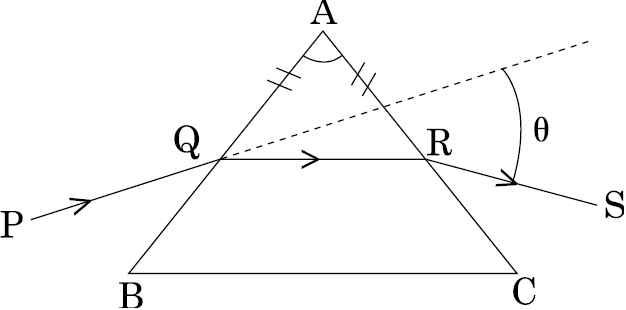
A ray PQ incident on the refracting face BA is refracted in the prism BAC as shown in the figure and emerges from the other refracting face AC as RS such that AQ = AR. If the angle of prism A = 60o and refractive index of material of prism is$\sqrt{3}$, calculate angle $\theta.$ 
A uniform vertical tube of circular cross-section contains a liquid. The contact angle is 90º. Consider a diameter of the tube lying in the surface of the liquid. The surface to the right of this diameter pulls the surface on the left of it. What keeps the surface on the left in equilibrium?
While gas from a cooking gas cylinder is used, the pressure does not fall appreciably till the last few minutes. Why?